What are Fundamental Rights?
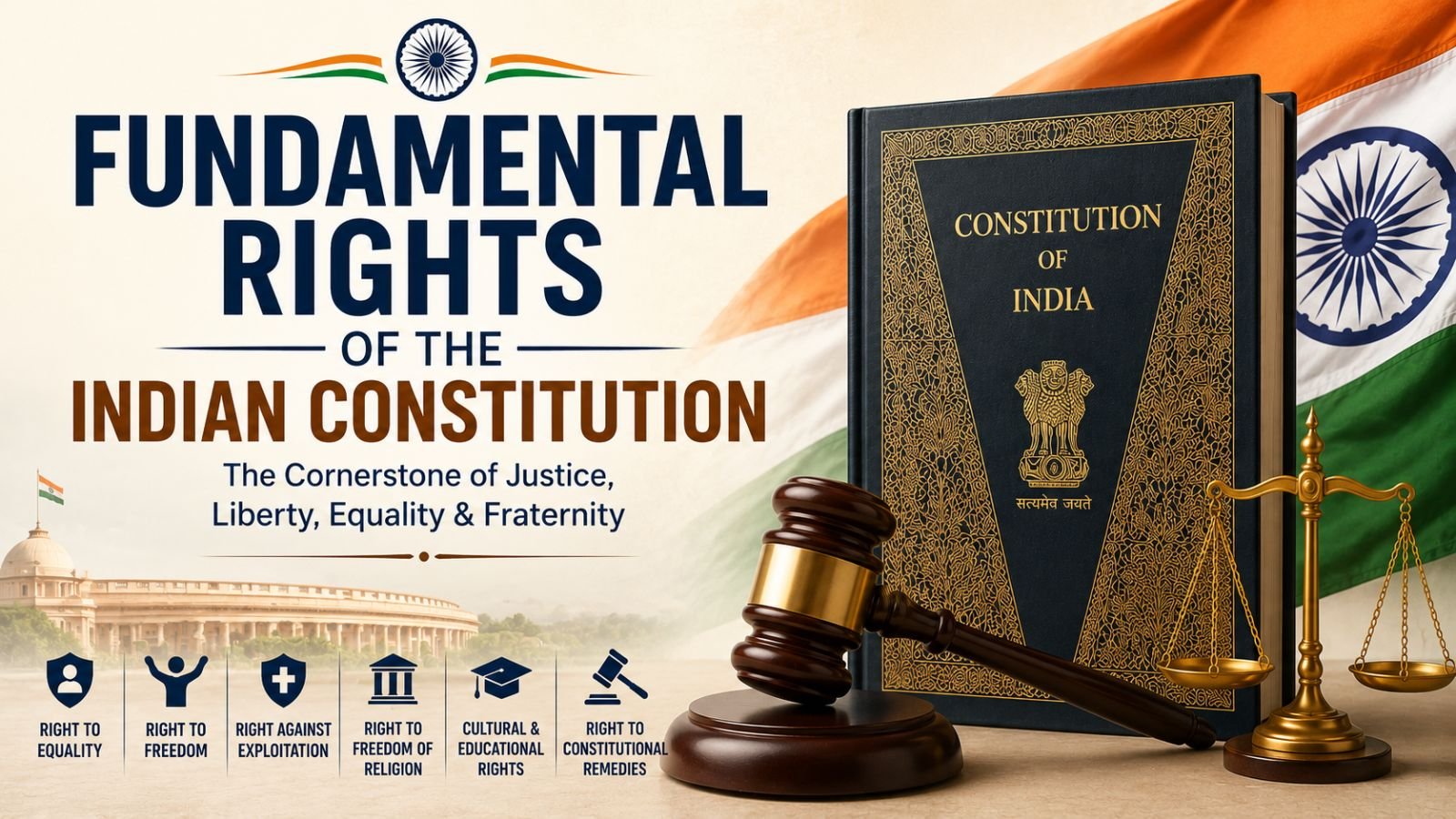
The Fundamental Rights of the Indian Constitution are the basic human rights guaranteed to every citizen of India. These rights are preserved in Part III of the Constitution (Articles 12 to 35). They protect individuals from any arbitrary action of the State and ensure equality, freedom, and dignity for all.
In this article, we will cover all 6 Fundamental Rights of the Indian Constitution, their important articles, key features, exceptions, and practice MCQs — perfect for UPSC, SSC CGL, State PSC, Railways, and Banking exams.
List of 6 Fundamental Rights
| Sr. No. | Fundamental Right | Articles |
|---|---|---|
| 1 | Right to Equality | 14–18 |
| 2 | Right to Freedom | 19–22 |
| 3 | Right Against Exploitation | 23–24 |
| 4 | Right to Freedom of Religion | 25–28 |
| 5 | Cultural and Educational Rights | 29–30 |
| 6 | Right to Constitutional Remedies | 32–35 |
1. Right to Equality (Articles 14–18)
The Right to Equality is the foundation of Indian democracy. It ensures that all citizens are treated equally before the law and prohibits discrimination based on religion, caste, race, sex etc.
Article 14 – Equality Before Law
The State shall not deny to any person equality before the law or the equal protection of the laws within the territory of India. This article contains two concepts:
- Equality before law (British concept) — No person is above the law
- Equal protection of law (American concept) — Equals must be treated equally
Article 15 – Prohibition of Discrimination
The State cannot discriminate against citizens on grounds of religion, race, caste, sex, or place of birth. However, special provisions can be made for:
- Women and children
- Socially and educationally backward classes like OBC, SC, and ST
Article 16 – Equality of Opportunity in Public Employment
No citizen shall be discriminated against in matters of public employment on grounds of religion, race, caste, sex, descent, place of birth, or residence. Reservations for SC/ST/OBC are permitted under this article.
Article 17 – Abolition of Untouchability
Untouchability is abolished and its practice in any form is an offence punishable under law. The Protection of Civil Rights Act, 1955 provides punishment for this offence.
Article 18 – Abolition of Titles
The State shall not confer any title like Lord, Sir, etc. except military and academic distinctions. However, Bharat Ratna, Padma Vibhushan, Padma Bhushan etc. are civilian honours, not titles so they are valid.
2. Right to Freedom (Articles 19–22)
Article 19 guarantees 6 freedoms to all citizens of India. These freedoms are not absolute and can be reasonably restricted by the State.
| Sr. No | Freedom under Art. 19 | Subject to Restrictions on grounds of... |
|---|---|---|
| 1 | 19(1)(a) – Freedom of speech & expression | Sovereignty, security, public order, morality, contempt of court |
| 2 | 19(1)(b) – Assemble peacefully without arms | Sovereignty & integrity, public order |
| 3 | 19(1)(c) – Form associations/unions | Sovereignty & integrity, public order, morality |
| 4 | 19(1)(d) – Move freely throughout India | Interests of general public, protection of SC/ST |
| 5 | 19(1)(e) – Reside and settle in any part of India | Interests of general public, protection of SC/ST |
| 6 | 19(1)(g) – Practice any profession or occupation | Interests of general public, professional qualifications |
Article 20 – Protection in Respect of Conviction for Offences
- No ex-post-facto law (No punishment for an act that was not an offence when committed)
- No double jeopardy (No person shall be prosecuted twice for the same offence)
- No self-incrimination (No person is compelled to be a witness against himself)
Article 20 cannot be suspended even during a National Emergency. This makes it one of the most important protections in the Constitution.
Article 21 – Protection of Life and Personal Liberty
No person shall be deprived of his life or personal liberty except according to procedure established by law. The Supreme Court has expanded Article 21 to include several rights such as:
- Right to Privacy (K.S. Puttaswamy case, 2017)
- Right to Education (before insertion of Art. 21A)
- Right to livelihood
- Right to clean environment
- Right to speedy trial
Article 21A – Right to Education
Inserted by the 86th Constitutional Amendment (2002), this article provides free and compulsory education to all children between 6 and 14 years of age. It is given effect by the Right to Education (RTE) Act, 2009.
Article 22 – Protection Against Arbitrary Arrest and Detention
- Every arrested person must be informed of the grounds of arrest
- The person must be produced before the nearest magistrate within 24 hours
- The person has the right to consult a legal practitioner of their choice
3. Right Against Exploitation (Articles 23–24)
Article 23 – Prohibition of Traffic in Human Beings and Forced Labour
This article prohibits traffic in human beings (bonded labour, beggars etc.) and other similar forms of forced labour. The Bonded Labour System (Abolition) Act, 1976 was enacted to implement this right.
Article 24 – Prohibition of Employment of Children in Factories
No child below the age of 14 years shall be employed in any factory, mine, or any other hazardous employment. The Child Labour (Prohibition and Regulation) Amendment Act, 2016 extended this protection to all work — not just hazardous work.
4. Right to Freedom of Religion (Articles 25–28)
| Sr. No | Article | Provision |
|---|---|---|
| 1 | 25 | Freedom of conscience and free profession, practice, and propagation of religion |
| 2 | 26 | Freedom to manage religious affairs (for religious denominations) |
| 3 | 27 | Freedom from payment of taxes for promotion of any religion |
| 4 | 28 | Freedom from religious instruction in educational institutions fully funded by the State |
India is a secular state — no religion is given special status by the State. However, the State can regulate secular activities associated with religious practice (e.g., temple management).
5. Cultural and Educational Rights (Articles 29–30)
Article 29 – Protection of Interests of Minorities
Any section of citizens having a distinct language, script, or culture has the right to conserve it. No citizen shall be denied admission to any State-funded educational institution on grounds of religion, race, caste, or language.
Article 30 – Right of Minorities to Establish Educational Institutions
All religious and linguistic minorities have the right to establish and administer educational institutions of their choice. The State shall not discriminate against minority-run institutions in granting aid.
6. Right to Constitutional Remedies (Article 32–35)
Dr. B.R. Ambedkar called Article 32 the “heart and soul of the Constitution.” It gives every citizen the right to move the Supreme Court for enforcement of Fundamental Rights.
Five Types of Writs under Article 32
| Sr. No | Writ | Meaning | Issued Against / For |
|---|---|---|---|
| 1 | Habeas Corpus | You may have the body | Illegal detention — to produce person before court |
| 2 | Mandamus | We command | Public officials — to perform their duty |
| 3 | Prohibition | To forbid | Lower courts — to stop exceeding jurisdiction |
| 4 | Certiorari | To be certified | Lower courts — to quash an illegal order |
| 5 | Quo Warranto | By what authority | Public offices — to challenge unauthorised holding of office |
High Courts can also issue writs under Article 226, but its scope is wider than Article 32. It can issue writs for both Fundamental Rights violations AND other legal purposes.
Important Exceptions & Limitations
- Fundamental Rights are not absolute — they can be reasonably restricted by Parliament
- They can be suspended during a National Emergency (Art. 352) under Arts. 358 & 359 — EXCEPT Arts. 20 & 21
- Armed forces personnel have restricted Fundamental Rights under Art. 33
- Fundamental Rights do not apply to laws under Ninth Schedule (subject to judicial review after I.R. Coelho case, 2007)
Fundamental Rights vs Directive Principles (DPSP)
| Sr. No | Basis | Fundamental Rights | Directive Principles (DPSP) |
|---|---|---|---|
| 1 | Nature | Justiciable (enforceable by courts) | Non-justiciable (not enforceable) |
| 2 | Part of Constitution | Part III | Part IV |
| 3 | Focus | Political & civil rights | Social & economic rights |
| 4 | Inspiration | US Bill of Rights | Irish Constitution |
| 5 | Primary duty of | State (negative obligations) | State (positive obligations) |
Important Constitutional Amendments Related to Fundamental Rights
| Sr. No | Amendment | Year | What Changed |
|---|---|---|---|
| 1 | 1st Amendment | 1951 | Added reasonable restrictions on Art. 19(1)(a); added 9th Schedule |
| 2 | 24th Amendment | 1971 | Parliament can amend Fundamental Rights |
| 3 | 25th Amendment | 1971 | Art. 31C — DPSPs can override Art. 14, 19 |
| 4 | 42nd Amendment | 1976 | Gave DPSP precedence over Fundamental Rights |
| 5 | 44th Amendment | 1978 | Right to Property removed from Fundamental Rights (now Art. 300A) |
| 6 | 86th Amendment | 2002 | Added Art. 21A — Right to Education |
Landmark Supreme Court Cases on Fundamental Rights
| Sr. No | Case | Year | Significance |
|---|---|---|---|
| 1 | A.K. Gopalan vs State of Madras | 1950 | Narrow interpretation of Art. 21 (procedure established by law) |
| 2 | Shankari Prasad vs Union of India | 1951 | Parliament can amend Fundamental Rights under Art. 368 |
| 3 | Golaknath vs State of Punjab | 1967 | Parliament cannot amend Fundamental Rights |
| 4 | Kesavananda Bharati vs State of Kerala | 1973 | Basic Structure Doctrine — Parliament cannot alter basic structure |
| 5 | Maneka Gandhi vs Union of India | 1978 | Wider interpretation of Art. 21 — procedure must be just, fair, and reasonable |
| 7 | Minerva Mills vs Union of India | 1980 | Struck down 42nd Amendment; balanced FRs and DPSPs |
| 8 | K.S. Puttaswamy vs Union of India | 2017 | Right to Privacy is a Fundamental Right under Art. 21 |
Exam Tips: What to Remember
- Part III = Fundamental Rights | Part IV = DPSP | Part IVA = Fundamental Duties
- Articles 12 & 13 define ‘State’ and declare inconsistent laws void
- 20 & 21 cannot be suspended during Emergency
- 32 itself is a Fundamental Right — Ambedkar called it ‘heart & soul’
- Right to Property removed by 44th Amendment (1978) — now Art. 300A (legal right, not fundamental)
- 21A (Right to Education) added by 86th Amendment (2002)
- Fundamental Rights are available mainly against State action, not private individuals
Conclusion
The 6 Fundamental Rights of the Indian Constitution are the backbone of Indian democracy. They protect citizens from arbitrary State action and ensure basic civil, political, and personal freedoms. Understanding their articles, key features, exceptions, and landmark cases is essential for every competitive exam aspirant.
- Part III → Articles 12–35 → 6 Fundamental Rights
- 12–13: Definition of State & void laws
- 14–18: Right to Equality
- 19–22: Right to Freedom
- 23–24: Right Against Exploitation
- 25–28: Right to Freedom of Religion
- 29–30: Cultural & Educational Rights
- 32–35: Right to Constitutional Remedies
Want to master Indian Polity for your next exam? Explore our recommended books list below and pick the one that matches your preparation stage. [Buy Now]
| Sr. No | Book | Author |
|---|---|---|
| 1. | Indian Polity | M. Laxmikanth |
| 2. | Objective Indian Polity | M. Laxmikanth |
| 3. | Indian Constitution at Work (NCERT Class XI) | NCERT |
| 4. | Contemporary World Politics (NCERT Class XII) | NCERT |
| 5. | The Constitution of India | Dr. B.R. Ambedkar |
| 6. | Governance in India | M. Laxmikanth |
| 7. | Indian Political Thought | O.P. Gauba |
Frequently Asked Questions (FAQs)
Q1. Fundamental Rights in the Indian Constitution are enshrined in which Part?
(a) Part II
(b) Part III
(c) Part IV
(d) Part IVA
Answer: (b) Part III
Explanation:
Fundamental Rights are contained in Part III of the Constitution (Articles 12–35).
Q2. Which article of the Indian Constitution abolishes untouchability?
(a) Article 14
(b) Article 15
(c) Article 17
(d) Article 18
Answer: (c) Article 17
Explanation:
Article 17 abolishes untouchability and makes its practice a punishable offence.
Q3. Which Fundamental Right was called the ‘heart and soul of the Constitution’ by Dr. B.R. Ambedkar?
(a) Article 19
(b) Article 21
(c) Article 32
(d) Article 14
Answer: (c) Article 32
Explanation:
Dr. Ambedkar described Article 32 (Right to Constitutional Remedies) as the ‘heart and soul’ because it provides the mechanism to enforce all other Fundamental Rights.
Q4. The Right to Education (Article 21A) was inserted by which Constitutional Amendment?
(a) 44th Amendment
(b) 73rd Amendment
(c) 86th Amendment
(d) 91st Amendment
Answer: (c) 86th Amendment Act, 2002
Explanation:
The 86th Constitutional Amendment Act, 2002 inserted Article 21A, making education a Fundamental Right for children aged 6–14 years.
Q5. Which of the following Fundamental Rights CANNOT be suspended even during a National Emergency?
(a) Article 19
(b) Article 21 only
(c) Articles 20 and 21
(d) Article 14
Answer: (c) Articles 20 and 21
Explanation:
Under Article 359, the President can suspend enforcement of Fundamental Rights during Emergency, EXCEPT Articles 20 and 21.
For daily GK updates, competitive exam preparation tips, and important static GK PDF, Join our Telegram Channel.
 Preparing for UPSC, SSC, Banking, RRB or State Exams?
Follow Test your gk for daily General Knowledge updates, important exam questions, and free study resources. Also checkout our social media platform.
Keep visiting Test Your GK (testyourgk.in) for more GK articles, MCQs, and study material for UPSC, SSC, Railways, Banking, and State PSC exams!
Stay connected
Join our community
