Introduction
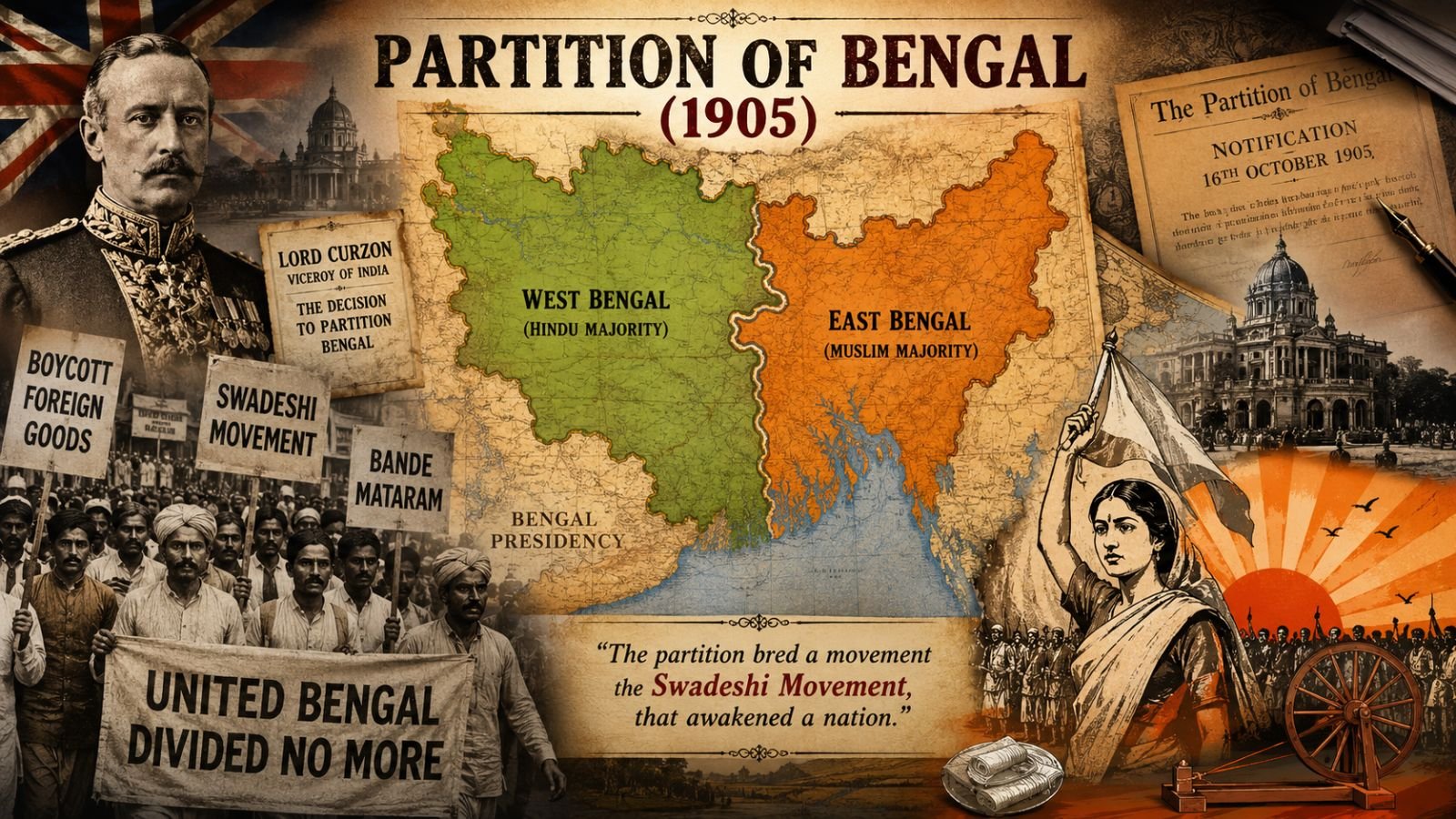
The Partition of Bengal (1905) is one of the most important topics in Modern Indian History for competitive exams like UPSC, SSC, Banking, Railways, and State PSC. Lord Curzon, the then Viceroy of India, divided Bengal into two parts on 16 October, 1905. The British government said this was done for better administration. But the real reason was to break Hindu-Muslim unity and weaken the growing nationalist movement in Bengal.
This event changed the course of the Indian freedom struggle. It led to the Swadeshi Movement, the boycott of British goods, and the rise of extremist leaders like Bal Gangadhar Tilak, Bipin Chandra Pal, and Lal Lajpat Rai. Due to huge public protest, the British were forced to reunite Bengal in 1911.
For exam preparation, this topic is asked again and again. Questions come on dates, viceroys, movements, and their outcomes. That is why we have prepared this set of 50+ MCQs on Partition of Bengal (1905). These questions cover every important fact, name, and date related to this event. Practicing these will help you build a strong base for your exam and also revise the topic quickly before your test.
Q.1 The Partition of Bengal was announced in which year?
A) 1903
B) 1904
C) 1905
D) 1906
Answer: C) 1905
Q.2 The Partition of Bengal came into effect on –
A) 15 August 1905
B) 16 October 1905
C) 26 January 1906
D) 1 January 1905
Answer: B) 16th October, 1905
Q.3 Who was the Viceroy of India during the Partition of Bengal?
A) Lord Ripon
B) Lord Curzon
C) Lord Minto II
D) Lord Hardinge II
Answer: B) Lord Curzon
Q.4 The Partition of Bengal was reversed because of –
A) Public opposition
B) World War I
C) Famine
D) Economic depression
Answer: A) Public opposition
Q.5 What was the capital of British India in 1905?
A) Bombay
B) Madras
C) Calcutta
D) Delhi
Answer: C) Calcutta
Q.6 Which event marked the beginning of a new phase of mass nationalism in India?
A) Revolt of 1857
B) Partition of Bengal (1905)
C) Champaran Satyagraha
D) Quit India Movement
Answer: B) Partition of Bengal (1905)
Q.7 Which new province was created after the Partition of Bengal?
A) Bihar and Orissa
B) Eastern Bengal and Assam
C) United Provinces
D) Central Provinces
Answer: B) Eastern Bengal and Assam
Q.8 What was the capital of Eastern Bengal and Assam?
A) Chittagong
B) Dhaka
C) Calcutta
D) Sylhet
Answer: B) Dhaka
Q.9 Which city remained the capital of the western part of Bengal after partition?
A) Dhaka
B) Murshidabad
C) Calcutta
D) Patna
Answer: C) Calcutta
Q.10 The Partition of Bengal led to the rise of which movement?
A) Khilafat Movement
B) Swadeshi Movement
C) Civil Disobedience Movement
D) Quit India Movement
Answer: B) Swadeshi Movement
Q.11 Which movement promoted the boycott of foreign goods after the partition?
A) Home Rule Movement
B) Swadeshi Movement
C) Non-Cooperation Movement
D) Bardoli Movement
Answer: B) Swadeshi Movement
Q.12 Which organization strongly opposed the Partition of Bengal?
A) Indian National Congress
B) Muslim League
C) Forward Bloc
D) Ghadar Party
Answer: A) Indian National Congress
Q.13 The slogan “Vande Mataram” became popular during which movement?
A) Swadeshi Movement
B) Quit India Movement
C) Civil Disobedience Movement
D) Home Rule Movement
Answer: A) Swadeshi Movement
Q.14 “Vande Mataram” was written by whom?
A) Rabindranath Tagore
B) Bankim Chandra Chattopadhyay
C) Bipin Chandra Pal
D) Aurobindo Ghosh
Answer: B) Bankim Chandra Chattopadhyay
Q.15 Which leader was popularly known as the “Grand Old Man of India” who opposed the Partition of Bengal?
A) Dadabhai Naoroji
B) Gopal Krishna Gokhale
C) Bal Gangadhar Tilak
D) Lala Lajpat Rai
Answer: A) Dadabhai Naoroji
Q.16 Who composed the song “Amar Sonar Bangla” during the anti-partition movement?
A) Bankim Chandra Chattopadhyay
B) Rabindranath Tagore
C) Kazi Nazrul Islam
D) Dwijendralal Roy
Answer: B) Rabindranath Tagore
Q.17 “Amar Sonar Bangla” is the national anthem of which country?
A) India
B) Nepal
C) Bangladesh
D) Sri Lanka
Answer: C) Bangladesh
Q.18 Which festival was used by Rabindranath Tagore to promote Hindu-Muslim unity during the anti-partition movement?
A) Holi
B) Raksha Bandhan
C) Diwali
D) Eid
Answer: B) Raksha Bandhan
Q.19 Which leader is associated with the slogan “Swaraj is my birthright”?
A) Bipin Chandra Pal
B) Bal Gangadhar Tilak
C) Lala Lajpat Rai
D) Aurobindo Ghosh
Answer: B) Bal Gangadhar Tilak
Q.20 The Partition of Bengal mainly affected which present-day regions?
A) Maharashtra and Gujarat
B) West Bengal and Bangladesh
C) Punjab and Haryana
D) Odisha and Andhra Pradesh
Answer: B) West Bengal and Bangladesh
Q.21 The anti-partition movement encouraged the use of –
A) Imported goods
B) Foreign textiles
C) Indigenous goods
D) British currency
Answer: C) Indigenous goods
Q.22 The boycott movement mainly targeted which goods?
A) Indian goods
B) British goods
C) French goods
D) Portuguese goods
Answer: B) British goods
Q.23 Which movement emerged as the immediate political response to the Partition of Bengal?
A) Swadeshi Movement
B) Civil Disobedience Movement
C) Quit India Movement
D) Home Rule Movement
Answer: A) Swadeshi Movement
Q.24 Who was one of the prominent leaders of the Swadeshi Movement in Bengal?
A) Aurobindo Ghosh
B) Mahatma Gandhi
C) Jawaharlal Nehru
D) Sardar Patel
Answer: A) Aurobindo Ghosh
Q.25 Which leader was known as the “Father of Revolutionary Nationalism” in Bengal?
A) Surendranath Banerjee
B) Bipin Chandra Pal
C) Motilal Nehru
D) C. Rajagopalachari
Answer: B) Bipin Chandra Pal
Q.26 Which leader led mass protests against the Partition of Bengal?
A) Surendranath Banerjee
B) Annie Besant
C) Mahatma Gandhi
D) Rajendra Prasad
Answer: A) Surendranath Banerjee
Q.27 Which organization was founded in 1906 partly due to political developments after the partition?
A) Indian National Army
B) Muslim League
C) Swaraj Party
D) Forward Bloc
Answer: B) Muslim League
Q.28 The All India Muslim League was founded at –
A) Lahore
B) Dhaka
C) Bombay
D) Delhi
Answer: B) Dhaka
Q.29 In which year was the Partition of Bengal annulled?
A) 1908
B) 1909
C) 1911
D) 1915
Answer: C) 1911
Q.30 Who announced the annulment of the Partition of Bengal?
A) Lord Curzon
B) Lord Minto II
C) King George V
D) Lord Reading
Answer: C) King George V
Q.31 The annulment of Bengal Partition was announced during –
A) Delhi Durbar of 1911
B) Lahore Session
C) Surat Session
D) Lucknow Session
Answer: A) Delhi Durbar of 1911
Q.32 After the cancellation, the capital of British India was shifted from Calcutta to –
A) Bombay
B) Delhi
C) Madras
D) Lucknow
Answer: B) Delhi
Q.33 The Partition of Bengal increased which form of nationalism?
A) Moderate nationalism only
B) Extremist nationalism
C) Socialist nationalism
D) Communist nationalism
Answer: B) Extremist nationalism
Q.34 Which of the following was NOT a method used during the Swadeshi Movement?
A) Boycott of foreign goods
B) Promotion of indigenous industries
C) National education
D) Payment of higher taxes
Answer: D) Payment of higher taxes
Q.35 Which education movement gained momentum after the partition?
A) National Education Movement
B) Adult Education Movement
C) Basic Education Movement
D) Literacy Mission
Answer: A) National Education Movement
Q.36 The National Council of Education was established in which year?
A) 1905
B) 1906
C) 1907
D) 1908
Answer: B) 1906
Q.37 Which leader was popularly called the “Uncrowned King of Bengal”?
A) Surendranath Banerjee
B) Bipin Chandra Pal
C) Aurobindo Ghosh
D) Prafulla Chaki
Answer: A) Surendranath Banerjee
Q.38 The Partition of Bengal was opposed because it was seen as an attempt to –
A) Increase trade
B) Divide and Rule
C) Improve education
D) Reduce taxes
Answer: B) Divide and Rule
Q.39 Which British policy was associated with the Partition of Bengal?
A) Subsidiary Alliance
B) Divide and Rule
C) Doctrine of Lapse
D) Ring Fence Policy
Answer: B) Divide and Rule
Q.40 Which section of Bengal had a Muslim majority?
A) Western Bengal
B) Eastern Bengal
C) Bihar
D) Orissa
Answer: B) Eastern Bengal
Q.41 Lord Curzon served as Viceroy of India from –
A) 1899–1905
B) 1905–1910
C) 1895–1900
D) 1901–1908
Answer: A) 1899–1905
Q.42 The Partition of Bengal was one of the major events during whose viceroyalty?
A) Lord Curzon
B) Lord Hardinge II
C) Lord Irwin
D) Lord Linlithgow
Answer: A) Lord Curzon
Q.43 Which Indian industry received a boost during the Swadeshi Movement?
A) Automobile industry
B) Shipbuilding only
C) Aviation industry
D) Textile industry
Answer: D) Textile industry
Q.44 Which city witnessed major anti-partition demonstrations?
A) Calcutta
B) Shimla
C) Delhi
D) Karachi
Answer: A) Calcutta
Q.45 Which leader was known as the “Father of the Indian Unrest” by the British?
A) Aurobindo Ghosh
B) Bipin Chandra Pal
C) Bal Gangadhar Tilak
D) Lala Lajpat Rai
Answer: C) Bal Gangadhar Tilak
Q.46 Which trio was popularly known as Lal-Bal-Pal?
A) Lala Lajpat Rai, Bal Gangadhar Tilak, Bipin Chandra Pal
B) Gandhi, Nehru, Patel
C) Naoroji, Gokhale, Tilak
D) Bose, Patel, Rajendra Prasad
Answer: A) Lala Lajpat Rai, Bal Gangadhar Tilak, Bipin Chandra Pal
Q.47 Which member of Lal-Bal-Pal belonged to Bengal?
A) Lala Lajpat Rai
B) Bal Gangadhar Tilak
C) Bipin Chandra Pal
D) None of these
Answer: C) Bipin Chandra Pal
Q.48 Which community formed the majority in Eastern Bengal after partition?
A) Hindu
B) Muslim
C) Sikh
D) Christian
Answer: B) Muslim
Q.49 Which was the main language spoken in Bengal?
A) Marathi
B) Bengali
C) Tamil
D) Gujarati
Answer: B) Bengali
Q.50 Which day was observed as a day of mourning against the Partition of Bengal?
A) 15 August 1905
B) 1 January 1905
C) 26 January 1906
D) 16th October, 1905
Answer: D) 16th October, 1905
Q.51 The anti-partition movement encouraged people to wear –
A) Imported clothes
B) Swadeshi clothes
C) Silk from Britain
D) European uniforms
Answer: B) Swadeshi clothes
Q.52 Which province was separated along with Eastern Bengal?
A) Punjab
B) Assam
C) Bihar
D) Orissa
Answer: B) Assam
Q.53 Which was the primary aim of the Swadeshi Movement?
A) Promotion of British trade
B) Promotion of Indian-made goods
C) Promotion of foreign education
D) Military recruitment
Answer: B) Promotion of Indian-made goods
Q.54 Which year marks both the annulment of Bengal Partition and the transfer of India’s capital to Delhi?
A) 1905
B) 1908
C) 1911
D) 1915
Answer: C) 1911
Q.55 Which movement encouraged the establishment of national schools?
A) Swadeshi Movement
B) Quit India Movement
C) Champaran Movement
D) Bardoli Movement
Answer: A) Swadeshi Movement
Conclusion
We hope these 50+ MCQs on the Partition of Bengal (1905) helped you understand and revise this important topic. This event is not just history, it is a favourite area for exam setters because it connects to many other topics like the Swadeshi Movement, the growth of the Indian National Congress, and the split between moderates and extremists.
📚 Want to master Indian History for UPSC, SSC & PSC exams?
The below History books covers it all, simplified, exam-focused, and topper-recommended. Check those books below on Amazon👇
Best Indian History Books for General Studies (UPSC/SSC/PSC):
| Sr. No | Book | Author |
|---|---|---|
| 1. | A Brief History of Modern India (Spectrum) | Rajiv Ahir |
| 2. | India's Ancient Past | R.S. Sharma |
| 3. | History of Medieval India | Satish Chandra |
| 4. | History of Modern India | Bipan Chandra |
| 5. | India's Struggle for Independence | Bipan Chandra |
| 6. | Independent India: Before and After | Bipan Chandra |
| 7. | The Wonder That Was India | A.L. Basham |
| 8. | Ancient India, Medieval India and Modern India (NCERT Class XI/XII) | NCERT |
Make sure you remember the key dates, names of leaders, and the effects of the partition, as these are most commonly tested. Regular revision of such MCQs will improve your speed and accuracy in the exam hall.
| Sr. No | Point | Details |
|---|---|---|
| 1. | Announced by | Lord Curzon, Viceroy of India |
| 2. | Date of Partition | 16th October, 1905 |
| 3. | Official reason given | Better administration, as Bengal was too big to govern |
| 4. | Real reason | To divide Hindus and Muslims and weaken the Nationalist Movement |
| 5. | Eastern Bengal and Assam (capital) | Dhaka — Muslim majority area |
| 6. | Bengal (remaining part) | West Bengal, Bihar, Odisha — Hindu majority area |
| 7. | Movement started against partition | Swadeshi Movement |
| 8. | Boycott | Indians boycotted British goods and promoted Swadeshi (Indian-made products) |
| 9. | Famous slogan | Vande Mataram |
| 10. | National song used in protest | Vande Mataram by Bankim Chandra Chattopadhyay |
| 11. | Key leaders (Lal-Bal-Pal) | Bal Gangadhar Tilak, Bipin Chandra Pal, Lal Lajpat Rai |
| 12. | Rabindranath Tagore's role | Composed "Amar Sonar Bangla"; tied Rakhi between Hindus and Muslims (1905) |
| 13. | Partition reversed (cancelled) | 1911, by King George V |
| 14. | Reason for reversal | Massive public protest and pressure from Indian National Congress |
| 15. | New arrangement after reunification | Bihar and Odisha separated from Bengal; Assam became a separate province |
| 16. | Capital of India shifted | From Calcutta to Delhi in 1911 (Delhi Durbar) |
| 17. | Importance for exams | Marks the beginning of mass political movements and extremist nationalism in India |
For daily GK updates, competitive exam preparation tips, and important static GK PDF, Join our Telegram Channel.
📚 Preparing for UPSC, SSC, Banking, RRB or State Exams?
Follow Test your gk for daily General Knowledge updates, important exam questions, and free study resources. Also checkout our social media platform
Keep practicing daily with Test your gk, and don’t forget to check our other MCQ sets on Modern Indian History for complete exam preparation. Good luck with your studies!
Stay connected
Join our community

1 thought on “50+ Gk MCQs on Partition of Bengal (1905) – Modern Indian History for Competitive Exams”