Introduction
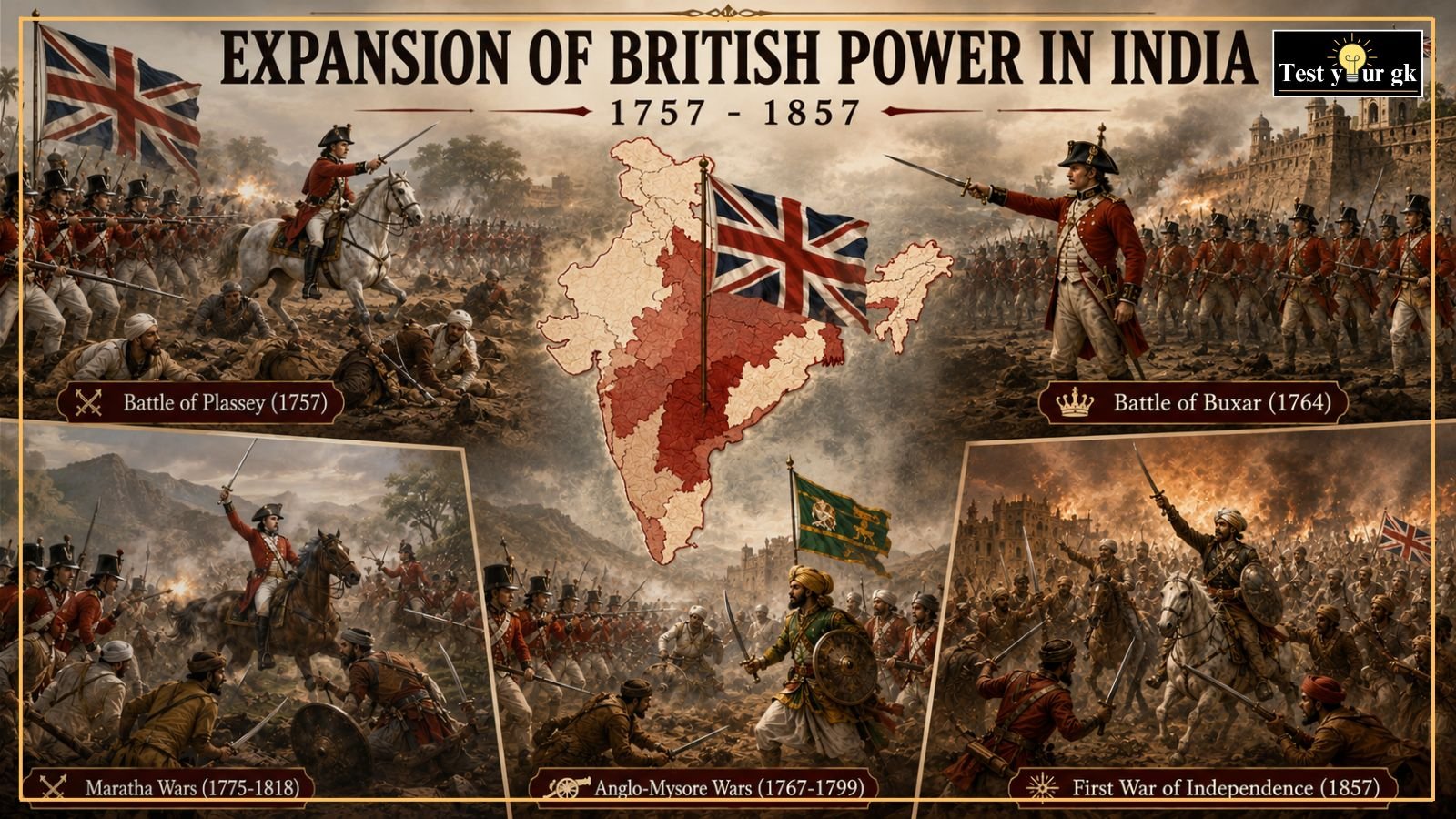
The period between 1757 and 1857 marks one of the most significant phases in Modern Indian History, the establishment and consolidation of British rule in India. Beginning with the Battle of Plassey (1757) and culminating in the Revolt of 1857, this century witnessed the transformation of the East India Company from a trading enterprise into a dominant political power controlling vast territories across the Indian subcontinent.
This period holds immense importance for competitive examinations such as UPSC, SSC, State PSCs, and Banking exams, as it forms the foundation for understanding India’s colonial history. Questions from this era frequently cover key battles (Plassey, Buxar), important treaties (Treaty of Allahabad, Subsidiary Alliance, Doctrine of Lapse), Governor-Generals and their policies (Robert Clive, Warren Hastings, Lord Wellesley, Lord Dalhousie), administrative and economic reforms, and the socio-political causes that eventually led to the Great Revolt of 1857.
This collection of 150+ Expansion of British Power in India GK questions and answers has been curated to help aspirants strengthen their conceptual understanding, revise important dates and events, and build the factual accuracy required to tackle History-based questions confidently in competitive exams.
Q.1 Which battle is generally regarded as the beginning of British political dominance in India?
Answer: Battle of Plassey (1757)
Q.2 When was the Battle of Plassey fought?
Answer: 23rd June, 1757
Q.3 Who commanded the British forces in the Battle of Plassey?
Answer: Robert Clive
Q.4 Who was the Nawab of Bengal during the Battle of Plassey?
Answer: Siraj-ud-Daulah
Q.5 Who betrayed Siraj-ud-Daulah in the Battle of Plassey?
Answer: Mir Jafar
Q.6 Who became the Nawab of Bengal after the Battle of Plassey?
Answer: Mir Jafar
Q.7 Which European trading company emerged as the dominant political power in Bengal after the Battle of Plassey?
Answer: English East India Company
Q.8 What was the main cause of the Battle of Plassey?
Answer: Conflict between the English East India Company and Siraj-ud-Daulah over political and commercial privileges.
Q.9 Which battle established British supremacy over Bengal, Bihar and Odisha?
Answer: Battle of Buxar
Q.10 When was the Battle of Buxar fought?
Answer: 22nd October, 1764
Q.11 Who commanded the British army in the Battle of Buxar?
Answer: Major Hector Munro
Q.12 Who were the three Indian rulers who fought against the British in the Battle of Buxar?
Answer: Mir Qasim (Nawab of Bengal), Shuja-ud-Daulah (Nawab of Awadh) and Shah Alam II (Mughal Emperor)
Q.13 Who was the Mughal emperor at the time of the Battle of Buxar?
Answer: Shah Alam II
Q.14 Who was the Nawab of Awadh during the Battle of Buxar?
Answer: Shuja-ud-Daulah
Q.15 Who was the Nawab of Bengal who fought against the British at Buxar?
Answer: Mir Qasim
Q.16 Which treaty followed the Battle of Buxar?
Answer: Treaty of Allahabad
Q.17 When was the Treaty of Allahabad signed?
Answer: 1765
Q.18 Who obtained the Diwani rights of Bengal, Bihar and Orissa from Shah Alam II?
Answer: Robert Clive
Q.19 What did the Diwani rights give the East India Company?
Answer: The right to collect revenue
Q.20 In which year was the Sanskrit College at Banaras established?
Answer: 1791
Q.21 Who introduced the Dual Government in Bengal?
Answer: Robert Clive
Q.22 In which year was the Dual Government introduced in Bengal?
Answer: 1765
Q.23 What was the main feature of the Dual Government in Bengal?
Answer: The Company controlled revenue while the Nawab nominally controlled administration.
Q.24 Who abolished the Dual Government in Bengal?
Answer: Warren Hastings
Q.25 In which year was the Dual Government abolished?
Answer: 1772
Q.26 How many Carnatic Wars were fought between the British and French in India?
Answer: Three
Q.27 When was the First Carnatic War fought?
Answer: 1746–1748
Q.28 Which treaty ended the First Carnatic War?
Answer: Treaty of Aix-la-Chapelle
Q.29 When was the Second Carnatic War fought?
Answer: 1749–1754
Q.30 When was the Third Carnatic War fought?
Answer: 1756–1763
Q.31 Which battle ended French political ambitions in India?
Answer: Battle of Wandiwash
Q.32 When was the Battle of Wandiwash fought?
Answer: 22nd January, 1760
Q.33 Who commanded the British forces at the Battle of Wandiwash?
Answer: Sir Eyre Coote
Q.34 Who commanded the French forces at the Battle of Wandiwash?
Answer: Count de Lally
Q.35 Which treaty ended the Third Carnatic War?
Answer: Treaty of Paris (1763)
Q.36 Who was the founder of the state of Mysore’s military power in the late 18th century?
Answer: Haider Ali
Q.37 How many Anglo-Mysore Wars were fought?
Answer: Four
Q.38 When was the First Anglo-Mysore War fought?
Answer: 1767–1769
Q.39 Who was the ruler of Mysore during the First Anglo-Mysore War?
Answer: Haider Ali
Q.40 Which treaty ended the First Anglo-Mysore War?
Answer: Treaty of Madras
Q.41 When was the Second Anglo-Mysore War fought?
Answer: 1780–1784
Q.42 Which Charter Act officially encouraged the spread of education in India?
Answer: Charter Act of 1813
Q.43 Who succeeded after the death of Haider Ali?
Answer: Tipu Sultan
Q.44 Which treaty ended the Second Anglo-Mysore War?
Answer: Treaty of Mangalore
Q.45 When was the Treaty of Mangalore signed?
Answer: 1784
Q.46 When was the Third Anglo-Mysore War fought?
Answer: 1790–1792
Q.47 Who was the Governor-General of India during the Third Anglo-Mysore War?
Answer: Lord Cornwallis
Q.48 Which treaty ended the Third Anglo-Mysore War?
Answer: Treaty of Seringapatam
Q.49 When was the Treaty of Seringapatam signed?
Answer: 1792
Q.50 When was the Fourth Anglo-Mysore War fought?
Answer: 1799
Q.51 When did Tipu Sultan die?
Answer: 4th May, 1799
Q.52 Where did Tipu Sultan died?
Answer: Seringapatam
Q.53 What title was given to Tipu Sultan because of his resistance to the British?
Answer: Tiger of Mysore
Q.54 Which foreign power did Tipu Sultan seek support from against the British?
Answer: France
Q.55 Which European military technology did Tipu Sultan famously used?
Answer: Iron-cased rockets
Q.56 Which Act was the first major step taken by the British Parliament to regulate the East India Company?
Answer: Regulating Act of 1773
Q.57 In which year was the Regulating Act passed?
Answer: 1773
Q.58 Who became the first Governor-General of Bengal under the Regulating Act?
Answer: Warren Hastings
Q.59 Who was the first Governor-General of Bengal?
Answer: Warren Hastings
Q.60 Which Act established the Supreme Court at Calcutta?
Answer: Regulating Act of 1773
Q.61 When was the Supreme Court at Calcutta established?
Answer: 1774
Q.62 Who was the first Chief Justice of the Supreme Court at Calcutta?
Answer: Sir Elijah Impey
Q.63 Which Act introduced the Board of Control?
Answer: Pitt’s India Act of 1784
Q.64 Who was the British Prime Minister associated with Pitt’s India Act?
Answer: William Pitt the Younger
Q.65 In which year was the Calcutta Madrasa established?
Answer: 1780-1781
Q.66 Who founded the Sanskrit College at Banaras?
Answer: Jonathan Duncan
Q.67 Which Act ended the East India Company’s commercial monopoly in India except for tea and trade with China?
Answer: Charter Act of 1813
Q.69 Which Charter Act ended the Company’s monopoly over tea and China trade?
Answer: Charter Act of 1833
Q.70 Which Charter Act made the Governor-General of Bengal the Governor-General of India?
Answer: Charter Act of 1833
Q.71 Who became the first Governor-General of India?
Answer: Lord William Bentinck
Q.72 Which Charter Act introduced an open competition system for civil services in principle?
Answer: Charter Act of 1853
Q.73 Which Charter Act separated the legislative and executive functions of the Governor-General’s Council?
Answer: Charter Act of 1853
Q.74 How much money was allocated annually for education under the Charter Act of 1813?
Answer: One lakh rupees
Q.75 Who founded the Paramahansa Mandali?
Answer: Dadoba Pandurang, Durgaram Mehtaji and his associates
Q.76 Who founded the Tattvabodhini Sabha?
Answer: Debendranath Tagore
Q.77 In which year was the Tattvabodhini Sabha founded?
Answer: 1839
Q.78 Who introduced the judicial reforms of 1772 in Bengal?
Answer: Warren Hastings
Q.79 Which court was established at Calcutta in 1772 for civil cases?
Answer: Sadr Diwani Adalat
Q.80 Which court was established for criminal cases under Warren Hastings’ reforms?
Answer: Faujdari Adalat
Q.81 Who was the first Governor-General to face impeachment in Britain?
Answer: Warren Hastings
Q.82 Who led the impeachment proceedings against Warren Hastings?
Answer: Edmund Burke
Q.83 In which year did Warren Hastings resign as Governor-General?
Answer: 1785
Q.84 Which famous trial was associated with Warren Hastings?
Answer: Impeachment trial
Q.85 Who was Maharaja Nand Kumar?
Answer: A Bengali official who accused Warren Hastings of corruption
Q.86 Who succeeded Warren Hastings as Governor-General of Bengal?
Answer: Lord Cornwallis
Q.87 When did Lord Cornwallis become Governor-General?
Answer: 1786
Q.88 Which revenue system was introduced by Lord Cornwallis in Bengal?
Answer: Permanent Settlement
Q.89 In which year was the Permanent Settlement introduced?
Answer: 1793
Q.90 Who were recognized as landowners under the Permanent Settlement?
Answer: Zamindars
Q.91 What was the main objective of the Permanent Settlement?
Answer: To fixed and stable land revenue permanently
Q.92 In which regions was the Permanent Settlement mainly introduced?
Answer: Bengal, Bihar and parts of Odisha
Q.93 Who wrote the famous ‘Minute on Indian Education’ in 1835?
Answer: Thomas Babington Macaulay
Q.94 Which educational policy favored Western knowledge through English?
Answer: Macaulay’s educational policy
Q.95 Who was the Governor-General when Macaulay’s educational policy was implemented?
Answer: Lord William Bentinck
Q.96 Who is often called the father of civil service reforms in India?
Answer: Lord Cornwallis
Q.97 Which institution was founded by the British in Calcutta in 1781 for the study of Islamic law and literature?
Answer: Calcutta Madrasa
Q.98 Who introduced the Subsidiary Alliance system in India?
Answer: Lord Wellesley
Q.99 When did Lord Wellesley became Governor-General of India?
Answer: 1798
Q.100 What was the main objective of the Subsidiary Alliance?
Answer: To bring Indian states under British political control
Q.101 Which Indian ruler was the first to accept the Subsidiary Alliance?
Answer: Nizam of Hyderabad (Nizam Ali Khan)
Q.102 Which treaty brought the Nizam of Hyderabad into the Subsidiary Alliance system?
Answer: Treaty of Hyderabad (1798)
Q.103 Which Maratha ruler accepted the Subsidiary Alliance through the Treaty of Bassein?
Answer: Peshwa Baji Rao II
Q.104 When was the Treaty of Bassein signed?
Answer: 1802
Q.105 Which Anglo-Maratha War followed the Treaty of Bassein?
Answer: Second Anglo-Maratha War
Q.106 Which major Indian state was annexed by the British in 1856 on the grounds of misgovernment?
Answer: Awadh
Q.107 Who was the last Mughal emperor at the time of the Revolt of 1857?
Answer: Bahadur Shah II
Q.108 Who was the first martyr of the Revolt of 1857 commonly identified in Indian history textbooks?
Answer: Mangal Pandey
Q.109 How many Anglo-Maratha Wars were fought?
Answer: Three
Q.110 When was the First Anglo-Maratha War fought?
Answer: 1775–1782
Q.111 Which treaty ended the First Anglo-Maratha War?
Answer: Treaty of Salbai
Q.112 When was the Treaty of Salbai signed?
Answer: 1782
Q.113 When was the Second Anglo-Maratha War fought?
Answer: 1803–1805
Q.114 Which treaty triggered the Second Anglo-Maratha War?
Answer: Treaty of Bassein
Q.115 When was the Third Anglo-Maratha War fought?
Answer: 1817–1818
Q.116 Who was the last Peshwa of the Maratha Empire?
Answer: Baji Rao II
Q.117 Which battle ended the power of the Peshwa?
Answer: Battle of Khadki and Battle of Koregaon
Q.118 In which year did the Peshwa’s political power end?
Answer: 1818
Q.119 In which year was Hindu College established?
Answer: 1817
Q.120 Who founded the Calcutta Madrasa?
Answer: Warren Hastings
Q.121 Who was the Governor-General of India during the Third Anglo-Maratha War?
Answer: Lord Hastings
Q.122 When did Lord Hastings serve as Governor-General?
Answer: 1813–1823
Q.123 Which war was fought between the British and the Gurkhas during Lord Hastings’ tenure?
Answer: Anglo-Nepalese War
Q.124 When was the Anglo-Nepalese War fought?
Answer: 1814–1816
Q.125 Which treaty ended the Anglo-Nepalese War?
Answer: Treaty of Sugauli
Q.126 When was the Treaty of Sugauli signed?
Answer: 1816
Q.127 Which community became famous for its military service to the British after the Anglo-Nepalese War?
Answer: Gurkhas
Q.128 Which tribal uprising occurred in the Rajmahal Hills during the late 18th century?
Answer: Pahariyas’ Rebellion
Q.129 Who introduced the Ryotwari system in the Madras Presidency?
Answer: Thomas Munro
Q.130 What was the basic feature of the Ryotwari system?
Answer: Revenue was collected directly from cultivators
Q.131 In which regions was the Ryotwari system mainly introduced?
Answer: Madras and Bombay Presidencies
Q.132 Who is closely associated with the Ryotwari system?
Answer: Thomas Munro
Q.133 What does the term ‘Ryot’ mean?
Answer: Cultivator or peasant
Q.134 Who introduced the Mahalwari system?
Answer: Holt Mackenzie
Q.135 When was the Mahalwari system introduced?
Answer: 1822
Q.136 What was the basic unit of revenue settlement under the Mahalwari system?
Answer: Village or Mahal
Q.137 Where was the Mahalwari system mainly introduced?
Answer: North-Western Provinces, Punjab and parts of Central India
Q.138 Which three major land revenue systems were introduced by the British in India?
Answer: Permanent Settlement, Ryotwari and Mahalwari
Q.139 Who became Governor-General of India in 1828?
Answer: Lord William Bentinck
Q.140 Who abolished Sati in British India?
Answer: Lord William Bentinck
Q.141 In which year was Sati abolished?
Answer: 1829
Q.142 Which regulation abolished Sati?
Answer: Bengal Sati Regulation, 1829
Q.143 Who was a major Indian social reformer associated with the campaign against Sati?
Answer: Raja Ram Mohan Roy
Q.144 Which tribal community led the Santhal Rebellion?
Answer: Santhal tribal community
Q.145 Which Governor-General introduced English as the medium of higher education in government policy?
Answer: Lord William Bentinck
Q.146 Which famous educational document was associated with Macaulay in 1835?
Answer: Macaulay’s Minute on Education
Q.147 In which year was Macaulay’s Minute on Education presented?
Answer: 1835
Q.148 Which language was promoted for higher education under Bentinck’s educational policy?
Answer: English
Q.149 Who founded the Sikh Empire in Punjab?
Answer: Maharaja Ranjit Singh
Q.150 What was the capital of Ranjit Singh’s empire?
Answer: Lahore
Q.151 Who founded the Brahmo Samaj?
Answer: Raja Ram Mohan Roy
Q.152 In which year was the Brahmo Samaj founded?
Answer: 1828
Q.153 What was the original name of the Brahmo Samaj?
Answer: Brahmo Sabha
Q.154 Which social reformer is known as the ‘Father of Indian Renaissance’?
Answer: Raja Ram Mohan Roy
Q.155 Which social evil did Raja Ram Mohan Roy strongly oppose?
Answer: Sati
Q.156 Which reformer advocated monotheism and opposed idol worship?
Answer: Raja Ram Mohan Roy
Q.157 Who founded the Atmiya Sabha?
Answer: Raja Ram Mohan Roy, 1815 Calcutta
Q.158 Who founded the Young Bengal Movement?
Answer: Henry Louis Vivian Derozio
Q.159 What was the main intellectual center of the Young Bengal Movement?
Answer: Hindu College, Calcutta
Q.160 Where did the Revolt of 1857 begin?
Answer: Meerut, on 10th May, 1857
Check Full Modern Indian History
Conclusion
A thorough understanding of the British conquest and consolidation of power in India between 1757 and 1857 is indispensable for every competitive exam aspirant. This period not only explains how a trading company evolved into a ruling power but also lays the groundwork for understanding subsequent developments in Modern Indian History, including the Revolt of 1857 and the eventual rise of the national movement.
Regular practice with GK questions like the ones covered in this article helps aspirants retain crucial facts, dates, and cause-effect relationships that are frequently tested in UPSC, SSC, Railways, Banking, and State-level competitive examinations. We recommend revising this topic periodically and attempting mock tests to reinforce your preparation.
Keep practicing, stay consistent, and make sure to bookmark this page for quick revision closer to your exam date.
For daily GK updates, competitive exam preparation tips, and important static GK PDF, Join our Telegram Channel.
📚 Preparing for UPSC, SSC, Banking, RRB or State Exams?
Follow Test your gk for daily General Knowledge updates, important exam questions, and free study resources. Also checkout our social media platform.
Stay connected with testyourgk for more such exam-oriented GK content on Modern Indian History and other important subjects.
Stay connected
Join our community
