Introduction
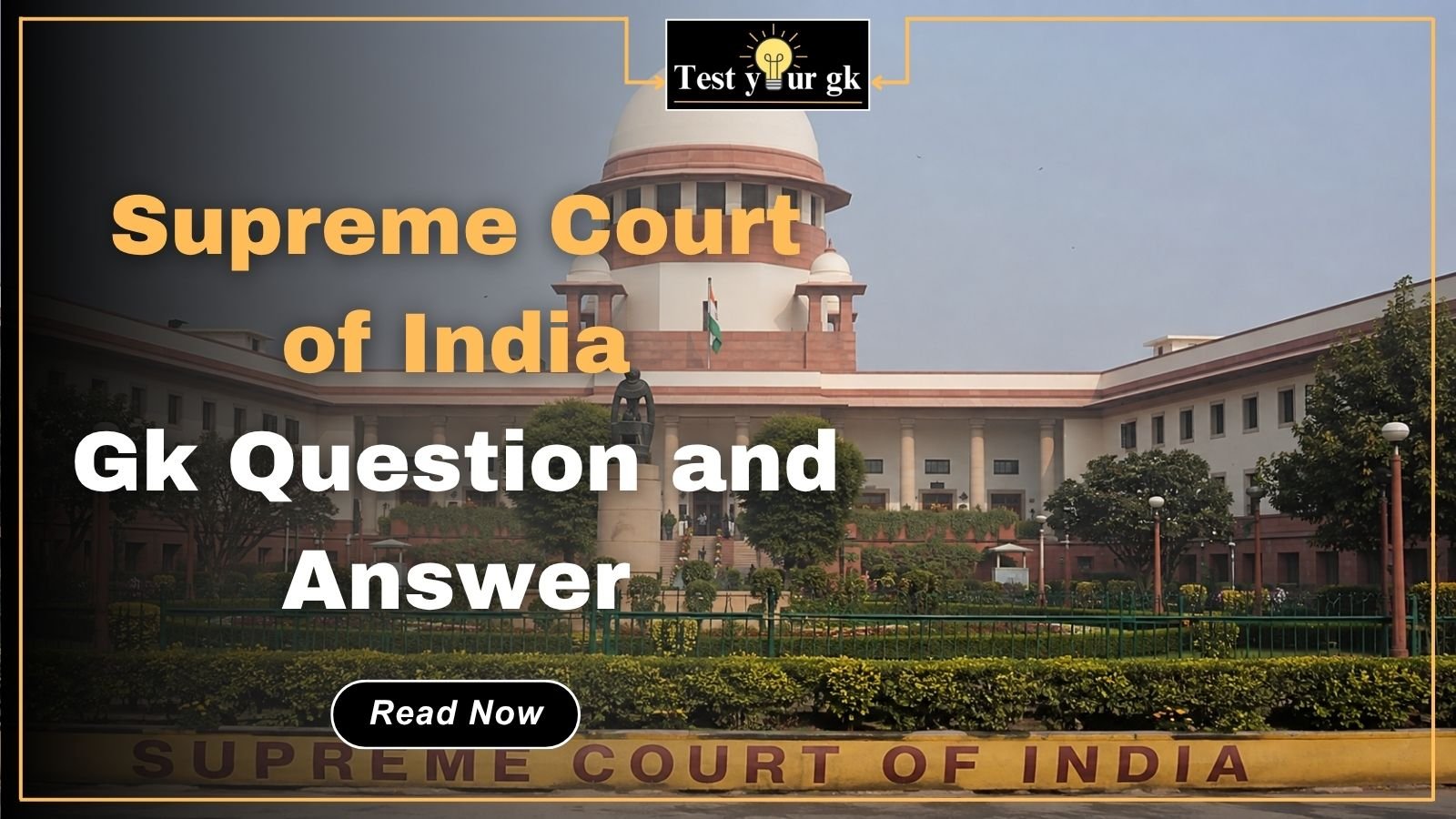
The ‘Supreme Court of India’ holds a place of immense importance in the Indian polity, being the apex judicial authority and the final interpreter of the Constitution. Established on 26th January, 1950, it acts as the guardian of Fundamental Rights and plays a decisive role in maintaining the balance of power among the Legislature, Executive, and Judiciary. For aspirants preparing for UPSC, SSC, Banking, and various State PSC examinations, questions related to the Supreme Court are a regular and important part of the General Knowledge and Polity sections.
Topics such as its composition, jurisdiction, landmark judgments, appointment and removal of judges, and constitutional provisions (Articles 124 to 147) are frequently tested. This article brings together 50+ Multiple Choice Questions on the Supreme Court of India, designed to strengthen your conceptual understanding and improve your accuracy for the exam hall. Practising these questions will help you revise key facts quickly and identify areas that need further attention.
Below given 50+ Supreme Court of India GK MCQs:
Q.1 Where is the Supreme Court of India located?
A) Mumbai
B) New Delhi
C) Kolkata
D) Chennai
Answer: B) New Delhi
Q.2 When was the Supreme Court of India inaugurated?
A) 26th January, 1950
B) 28th January, 1950
C) 15th August, 1947
D) 26th November, 1949
Answer: B) 28th January, 1950
Q.3 Which Article of the Indian Constitution deals with the establishment and constitution of the Supreme Court?
A) Article 124
B) Article 129
C) Article 136
D) Article 143
Answer: A) Article 124
Q.4 Who was the first Chief Justice of India?
A) Justice M. Patanjali Sastri
B) Justice Harilal Jekisundas Kania
C) Justice B. K. Mukherjea
D) Justice S. R. Das
Answer: B) Justice Harilal Jekisundas Kania
Q.5 What does PIL stand for?
A) Public Interest Litigation
B) Private Indian Law
C) Public Indian Law
D) Parliamentary Interest Litigation
Answer: A) Public Interest Litigation
Q.6 Which Article declares the Supreme Court to be a court of record?
A) Article 124
B) Article 129
C) Article 130
D) Article 136
Answer: B) Article 129
Q.7 Which Article deals with the seat of the Supreme Court?
A) Article 128
B) Article 129
C) Article 130
D) Article 131
Answer: C) Article 130
Q.8 Who appoints the Chief Justice of India?
A) Prime Minister of India
B) President of India
C) Parliament
D) Law Minister
Answer: B) President of India
Also Read
Q.9 Who appoints the judges of the Supreme Court?
A) Prime Minister of India
B) Chief Justice of India
C) President of India
D) Parliament
Answer: C) President of India
Q.10 What is the retirement age of a Supreme Court judge in India?
A) 60 years
B) 62 years
C) 65 years
D) 70 years
Answer: C) 65 years
Q.11 What is the retirement age of a High Court judge in India?
A) 60 years
B) 62 years
C) 65 years
D) 68 years
Answer: B) 62 years
Q.12 Which Article provides for the appointment of acting Chief Justice of India?
A) Article 126
B) Article 127
C) Article 128
D) Article 129
Answer: A) Article 126
Q.13 Which Article deals with the appointment of ad hoc judges of the Supreme Court?
A) Article 126
B) Article 127
C) Article 128
D) Article 129
Answer: B) Article 127
Q.14 Which Article deals with the attendance of retired judges at sittings of the Supreme Court?
A) Article 127
B) Article 128
C) Article 129
D) Article 130
Answer: B) Article 128
Q.15 Which Article gives the Supreme Court power to issue writs for the enforcement of Fundamental Rights?
A) Article 32
B) Article 131
C) Article 136
D) Article 143
Answer: A) Article 32
Q.16 Who called Article 32 the “Heart and Soul” of the Constitution?
A) Jawaharlal Nehru
B) Dr. B. R. Ambedkar
C) Sardar Vallabha Bhai Patel
D) Dr. Rajendra Prasad
Answer: B) Dr. B. R. Ambedkar
Q.17 Which jurisdiction of the Supreme Court deals with disputes between the Union and States?
A) Appellate jurisdiction
B) Advisory jurisdiction
C) Original jurisdiction
D) Review jurisdiction
Answer: C) Original jurisdiction
Q.18 Which Article deals with the original jurisdiction of the Supreme Court?
A) Article 130
B) Article 131
C) Article 132
D) Article 133
Answer: B) Article 131
Q.19 Which jurisdiction allows the Supreme Court to hear appeals from lower courts?
A) Original jurisdiction
B) Appellate jurisdiction
C) Advisory jurisdiction
D) Administrative jurisdiction
Answer: B) Appellate jurisdiction
Q.20 Which Article deals with the advisory jurisdiction of the Supreme Court?
A) Article 136
B) Article 137
C) Article 142
D) Article 143
Answer: D) Article 143
Q.21 Who can seek the advisory opinion of the Supreme Court?
A) Prime Minister
B) President of India
C) Chief Justice of India
D) Speaker of Lok Sabha
Answer: B) President of India
Q.22 Under which Article can the Supreme Court review its own judgments?
A) Article 136
B) Article 137
C) Article 141
D) Article 142
Answer: B) Article 137
Q.23 Which Article states that the law declared by the Supreme Court shall be binding on all courts in India?
A) Article 139
B) Article 140
C) Article 141
D) Article 142
Answer: C) Article 141
Q.24 Which Article gives the Supreme Court the power to do complete justice?
A) Article 141
B) Article 142
C) Article 143
D) Article 144
Answer: B) Article 142
Q.25 Which Article requires all authorities to act in aid of the Supreme Court?
A) Article 142
B) Article 143
C) Article 144
D) Article 145
Answer: C) Article 144
Q.26 Who is the head of the Indian judiciary?
A) Attorney General of India
B) Chief Justice of India
C) Law Minister
D) President of India
Answer: B) Chief Justice of India
Q.27 What is the minimum age required to become a Supreme Court judge?
A) 35 years
B) 40 years
C) No minimum age is prescribed
D) 50 years
Answer: C) No minimum age is prescribed
Q.28 Which of the following is a qualification for appointment as a Supreme Court judge?
A) Must have been a High Court judge for at least 5 years
B) Must have been a High Court judge for at least 10 years
C) Must have been a Member of Parliament
D) Must be a retired civil servant
Answer: A) Must have been a High Court judge for at least 5 years
Q.29 A person can also qualify for appointment as a Supreme Court judge if they have been an advocate of a High Court for at least:
A) 5 years
B) 7 years
C) 10 years
D) 15 years
Answer: C) 10 years
Q.30 A person may also be appointed as a Supreme Court judge if the President considers them a:
A) Distinguished politician
B) Distinguished jurist
C) Senior civil servant
D) Member of Parliament
Answer: B) Distinguished jurist
Q.31 Who is the constitutional head of the Indian Union?
A) Prime Minister of India
B) President of India
C) Chief Justice of India
D) Vice-President of India
Answer: B) President of India
Q.32 A Supreme Court judge can resign by addressing the resignation letter to the:
A) Chief Justice of India
B) Prime Minister of India
C) President of India
D) Law Minister
Answer: C) President of India
Q.33 How can a Supreme Court judge be removed from office?
A) By the President alone
B) By Parliament through a special procedure
C) By the Chief Justice of India
D) By the Prime Minister
Answer: B) By Parliament through a special procedure
Q.34 Which Schedule of the Constitution contains provisions relating to the salaries and allowances of Supreme Court judges?
A) Second Schedule
B) Third Schedule
C) Fourth Schedule
D) Fifth Schedule
Answer: A) Second Schedule
Q.35 Which type of majority is required in Parliament for the removal of a Supreme Court judge?
A) Simple majority
B) Special majority
C) Absolute majority only
D) Two-thirds of the total population
Answer: B) Special majority
Q.36 Which writ is issued to produce a person who has been unlawfully detained?
A) Mandamus
B) Habeas Corpus
C) Certiorari
D) Quo Warranto
Answer: B) Habeas Corpus
Q.37 Which writ means “We Command”?
A) Mandamus
B) Habeas Corpus
C) Prohibition
D) Certiorari
Answer: A) Mandamus
Q.38 Which writ is issued to prevent a lower court from exceeding its jurisdiction?
A) Habeas Corpus
B) Mandamus
C) Prohibition
D) Quo Warranto
Answer: C) Prohibition
Q.39 Which writ is used to quash an order of a lower court or tribunal?
A) Certiorari
B) Mandamus
C) Habeas Corpus
D) Quo Warranto
Answer: A) Certiorari
Q.40 Which writ challenges the legal authority of a person holding a public office?
A) Prohibition
B) Quo Warranto
C) Mandamus
D) Certiorari
Answer: B) Quo Warranto
Q.41 Which Article empowers the Supreme Court to issue writs for Fundamental Rights?
A) Article 30
B) Article 32
C) Article 226
D) Article 368
Answer: B) Article 32
Q.42 Which court has wider power to issue writs: the Supreme Court or High Court?
A) Supreme Court
B) High Court
C) Both have exactly the same power
D) District Court
Answer: B) High Court
Q.43 Which Article gives High Courts the power to issue writs?
A) Article 32
B) Article 136
C) Article 226
D) Article 227
Answer: C) Article 226
Q.44 What is the maximum strength of the Supreme Court of India, including the Chief Justice of India?
A) 31 judges
B) 38 judges
C) 35 judges
D) 40 judges
Answer: B) 38 judges
Q.45 Which Article gives the Supreme Court special leave to appeal against judgments or orders of courts and tribunals?
A) Article 132
B) Article 134
C) Article 136
D) Article 139
Answer: C) Article 136
Q.46 Which case is associated with the Basic Structure Doctrine?
A) Kesavananda Bharati case
B) Golaknath case
C) Minerva Mills case
D) Maneka Gandhi case
Answer: A) Kesavananda Bharati case
Q.47 In which year was the Kesavananda Bharati judgment delivered?
A) 1967
B) 1973
C) 1975
D) 1977
Answer: B) 1973
Q.48 Which Supreme Court case established that Parliament cannot destroy the basic structure of the Constitution?
A) Kesavananda Bharati case
B) A. K. Gopalan case
C) Shankari Prasad case
D) Berubari Union case
Answer: A) Kesavananda Bharati case
Q.49 Which case is famous for expanding the interpretation of the Right to Life under Article 21?
A) Maneka Gandhi v. Union of India
B) Golaknath v. State of Punjab
C) Kesavananda Bharati v. State of Kerala
D) Shankari Prasad v. Union of India
Answer: A) Maneka Gandhi v. Union of India
Q.50 Which Supreme Court case is associated with the right to privacy as a fundamental right?
A) K.S Puttaswamy case
B) Kesavananda Bharati case
C) Golaknath case
D) Minerva Mills case
Answer: A) K.S Puttaswamy case
Q.51 In which year did the Supreme Court recognize privacy as a fundamental right in the Puttaswamy judgment?
A) 2014
B) 2015
C) 2017
D) 2019
Answer: C) 2017
Q.52 Which Supreme Court case struck down Section 377 of the Indian Penal Code to the extent it criminalized consensual same-sex relations between adults?
A) Navtej Singh Johar case
B) Vishaka case
C) Shah Bano case
D) Minerva Mills case
Answer: A) Navtej Singh Johar case
Q.53 Which case led to the Supreme Court guidelines on sexual harassment of women at the workplace?
A) Vishaka v. State of Rajasthan
B) Shah Bano case
C) Golaknath case
D) Kesavananda Bharati case
Answer: A) Vishaka v. State of Rajasthan
Q.54 Which Supreme Court case is associated with the constitutional limits on the use of President’s Rule?
A) S. R. Bommai v. Union of India
B) Kesavananda Bharati case
C) Golaknath case
D) Vishaka case
Answer: A) S. R. Bommai v. Union of India
Q.55 Which Article deals with the power of the Supreme Court to transfer certain cases?
A) Article 139A
B) Article 140
C) Article 141
D) Article 142
Answer: A) Article 139A
Conclusion
A strong knowledge of the Supreme Court of India is essential for anyone preparing for competitive examinations, as this topic consistently appears across Polity and General Knowledge sections. By practising the 50+ MCQs covered in this article, you have revised important aspects such as the Court’s structure, powers, landmark cases, and constitutional articles governing its functioning.
Regular practice of such questions not only builds factual recall but also sharpens your ability to handle tricky, application-based questions in the actual exam. We recommend revisiting this quiz periodically and pairing it with reading the relevant constitutional articles to reinforce your understanding.
Want to master Indian Polity for your next exam? Explore our recommended books list below and pick the one that matches your preparation stage. [Buy Now]
| Sr. No | Book | Author |
|---|---|---|
| 1. | Indian Polity | M. Laxmikanth |
| 2. | Objective Indian Polity | M. Laxmikanth |
| 3. | Indian Constitution at Work (NCERT Class XI) | NCERT |
| 4. | Contemporary World Politics (NCERT Class XII) | NCERT |
| 5. | The Constitution of India | Dr. B.R. Ambedkar |
| 6. | Governance in India | M. Laxmikanth |
| 7. | Indian Political Thought | O.P. Gauba |
Keep practising consistently, and don’t forget to explore more GK quizzes on related topics like the Parliament, Fundamental Rights, and the Indian Constitution to build a well-rounded preparation strategy.
For daily GK updates, competitive exam preparation tips, and important static GK PDF, Join our Telegram Channel.
📚 Preparing for UPSC, SSC, Banking, RRB or State Exams?
Follow Test your gk for daily General Knowledge updates, important exam questions, and free study resources. Also checkout our social media platform.
Stay connected
Join our community
