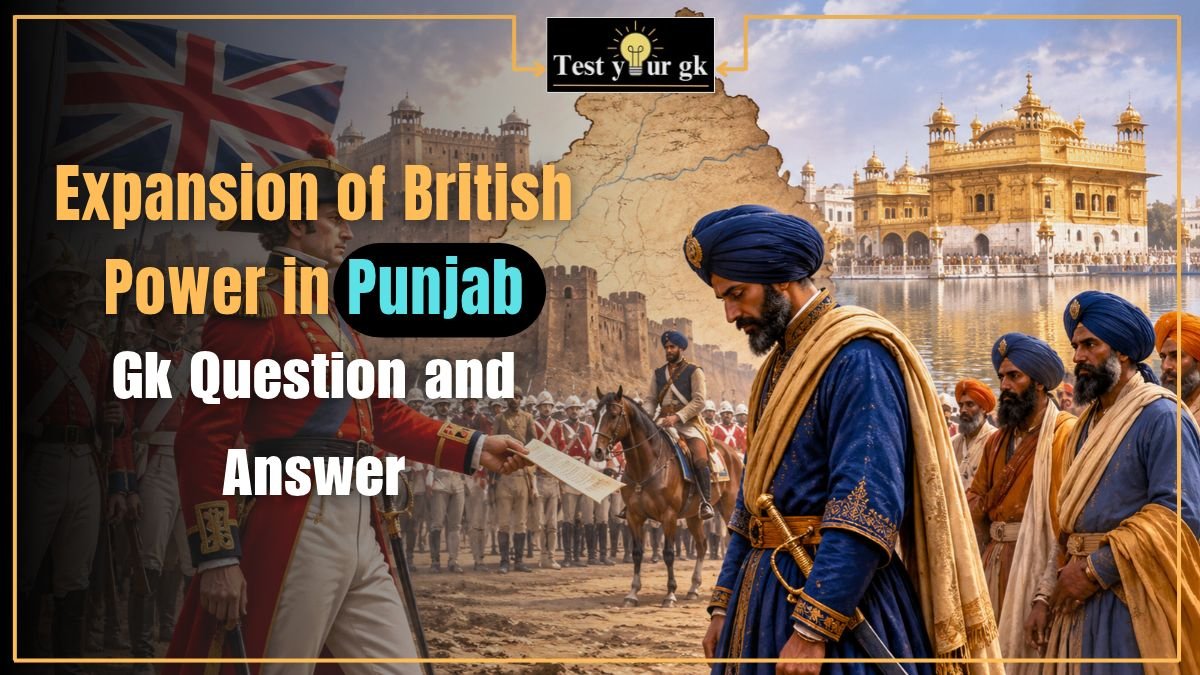
Introduction:
The expansion of British power in Punjab is one of the most important chapters of modern Indian history. Maharaja Ranjit Singh (1780–1839) ruled a strong and well-organised Sikh Empire with Lahore as its capital. He crowned himself Maharaja in 1801 and brought Multan, Kashmir and Peshawar under his rule. By the Treaty of Amritsar (1809), he accepted the Sutlej as the boundary with British territory, and the Cis-Sutlej states came under British protection. For the rest of his life, he kept friendly relations with the East India Company while building a powerful army with the help of European officers.
After his death in 1839, the empire weakened quickly. Court intrigues, murders among the royal family, and a powerful but divided army created instability in Lahore. The British took advantage of this situation. Two wars followed, the First Anglo-Sikh War (1845–46) and the Second Anglo-Sikh War (1848–49). Together they ended Sikh independence and brought Punjab fully under British control.
Below Given 50+ British Expansion in Punjab Gk MCQs:
Q.1 Who founded the Sikh Empire (Sarkar-i-Khalsa) in Punjab?
A) Banda Singh Bahadur
B) Maharaja Ranjit Singh
C) Maharaja Duleep Singh
D) Guru Gobind Singh
Answer: B) Maharaja Ranjit Singh (crowned Maharaja of Punjab in 1801, with Lahore as his capital)
Q.2 In which year was Maharaja Ranjit Singh born?
A) 1765
B) 1792
C) 1780
D) 1799
Answer: C) 1780 (born at Gujranwala on 13th November, 1780)
Q.3 Which title is popularly associated with Maharaja Ranjit Singh?
A) Sher-e-Punjab
B) Sher-e-Kashmir
C) Sher-e-Mysore
D) Sher-e-Bengal
Answer: A) Sher-e-Punjab (“Lion of Punjab”)
Q.4 To which misl did Ranjit Singh belong?
A) Bhangi Misl
B) Ahluwalia Misl
C) Sukerchakia Misl
D) Kanhaiya Misl
Answer: C) Sukerchakia Misl (his family was based at Gujranwala)
Q.5 Which disease cost Ranjit Singh the sight of his left eye in childhood?
A) Measles
B) Cholera
C) Typhoid
D) Smallpox
Answer: D) Smallpox (he is often called “Kana Maharaja” for this reason)
Q.6 In which year did Ranjit Singh capture Lahore?
A) 1799
B) 1792
C) 1802
D) 1809
Answer: A) 1799 (taken from the Bhangi chiefs)
Q.7 In which year was Ranjit Singh crowned Maharaja of Punjab?
A) 1799
B) 1806
C) 1801
D) 1809
Answer: C) 1801 (coronation held on Baisakhi, 12th April, 1801)
Q.8 Which sacred city did Ranjit Singh bring under his control in 1802?
A) Multan
B) Amritsar
C) Peshawar
D) Kashmir
Answer: B) Amritsar (captured from the Bhangi misl)
Q.9 Ranjit Singh’s government was officially known as:
A) Dal Khalsa
B) Sarbat Khalsa
C) Gurmata Darbar
D) Sarkar-i-Khalsa
Answer: D) Sarkar-i-Khalsa (also called Sarkar Khalsaji)
Q.10 In which year did Ranjit Singh capture Multan?
A) 1813
B) 1818
C) 1819
D) 1834
Answer: B) 1818 (Multan was taken after a siege)
Q.11 In which year did Ranjit Singh annex Kashmir?
A) 1809
B) 1819
C) 1818
D) 1834
Answer: B) 1819 (Kashmir was taken from the Afghan governor)
Q.12 In which year did Ranjit Singh annex Peshawar?
A) 1819
B) 1823
C) 1834
D) 1837
Answer: C) 1834 (Hari Singh Nalwa became its governor)
Q.13 From whom did Ranjit Singh obtain the Koh-i-Noor diamond in 1813?
A) Shah Shuja
B) Dost Mohammad Khan
C) Nadir Shah
D) Zaman Shah
Answer: A) Shah Shuja (Shah Shuja was the exiled Afghan ruler who sought refuge in Lahore)
Q.14 Which famous Sikh general was killed in the Battle of Jamrud in 1837?
A) Sham Singh Attariwala
B) Dewan Mohkam Chand
C) Fateh Singh Ahluwalia
D) Hari Singh Nalwa
Answer: D) Hari Singh Nalwa (Sikh frontier commander and governor of Peshawar)
Q.15 Which Dogra general under Gulab Singh conquered Ladakh in 1834–35?
A) Zorawar Singh
B) Hari Singh Nalwa
C) Dhian Singh
D) Lehna Singh Majithia
Answer: A) Zorawar Singh (served the Raja of Jammu)
Q.16 Which of the following was not a European officer in Ranjit Singh’s army?
A) Jean-François Allard
B) Charles Metcalfe
C) Jean-Baptiste Ventura
D) Paolo Avitabile
Answer: B) Charles Metcalfe (Metcalfe was the British envoy who negotiated the 1809 treaty)
Q.17 The Treaty of Lahore (1806) between Ranjit Singh and Lord Lake was linked with the flight of which Maratha chief into Punjab?
A) Daulat Rao Scindia
B) Baji Rao II
C) Yashwantrao Holkar
D) Raghuji Bhonsle II
Answer: C) Yashwantrao Holkar (Ranjit Singh agreed not to help Holkar against the British)
Q.18 Who was the British envoy sent to Ranjit Singh’s court in 1808 who negotiated the Treaty of Amritsar?
A) David Ochterlony
B) Henry Lawrence
C) Alexander Burnes
D) Charles Metcalfe
Answer: D) Charles Metcalfe (the treaty was signed on 25th April, 1809)
Q.19 Who was the Governor-General of India when the Treaty of Amritsar (1809) was signed?
A) Lord Wellesley
B) Lord Minto I
C) Lord Hastings
D) Lord Auckland
Answer: B) Lord Minto I (Governor-General from 1807 to 1813)
Q.20 The Treaty of Amritsar (1809) fixed which river as the boundary between Ranjit Singh’s territory and British territory?
A) Sutlej
B) Beas
C) Ravi
D) Indus
Answer: A) Sutlej (Ranjit Singh’s expansion south of the river was checked)
Q.21 Which treaty brought the Cis-Sutlej Sikh states under British protection?
A) Treaty of Lahore (1806)
B) Treaty of Bhairowal (1846)
C) Tripartite Treaty (1838)
D) Treaty of Amritsar (1809)
Answer: D) Treaty of Amritsar (1809) (it ended Ranjit Singh’s ambitions beyond the Sutlej)
Q.22 Which of these was a Cis-Sutlej state that sought British protection against Ranjit Singh?
A) Patiala
B) Kapurthala
C) Multan
D) Peshawar
Answer: A) Patiala (Nabha and Jind were also Cis-Sutlej states)
Q.23 Which British officer led the troops sent to the Sutlej frontier in 1809, setting up a garrison at Ludhiana?
A) Hugh Gough
B) Harry Smith
C) Gerard Lake
D) David Ochterlony
Answer: D) David Ochterlony (Ludhiana became the British frontier post)
Q.24 At which place did Ranjit Singh meet Governor-General Lord William Bentinck in 1831?
A) Amritsar
B) Lahore
C) Ambala
D) Rupar (Ropar)
Answer: D) Rupar (Ropar) (the meeting was held on the Sutlej and reaffirmed friendship)
Q.25 In which year was the Tripartite Treaty signed among the British, Ranjit Singh and Shah Shuja?
A) 1838
B) 1831
C) 1839
D) 1842
Answer: A) 1838 (signed in June 1838)
Q.26 What was the main aim of the Tripartite Treaty (1838)?
A) To keep Dost Mohammad Khan on the Afghan throne
B) To fix the Sutlej as the boundary of Punjab
C) To restore Shah Shuja to the throne of Afghanistan
D) To hand Sindh over to the Sikhs
Answer: C) To restore Shah Shuja to the throne of Afghanistan (it led to the First Anglo-Afghan War (1839–42))
Q.27 Who was the Governor-General of India at the time of the Tripartite Treaty of 1838?
A) Lord William Bentinck
B) Lord Ellenborough
C) Lord Hardinge
D) Lord Auckland
Answer: D) Lord Auckland (Governor-General from 1836 to 1842)
Q.28 In which year did Maharaja Ranjit Singh die?
A) 1835
B) 1840
C) 1843
D) 1839
Answer: D) 1839 (died at Lahore on 27th June, 1839)
Q.29 Who succeeded Ranjit Singh as the Maharaja of Punjab?
A) Sher Singh
B) Kharak Singh
C) Nau Nihal Singh
D) Duleep Singh
Answer: B) Kharak Singh (his eldest son, who ruled 1839–40)
Q.30 Which Sikh prince died in 1840 when a gateway collapsed as he returned from his father’s cremation?
A) Sher Singh
B) Peshaura Singh
C) Duleep Singh
D) Nau Nihal Singh
Answer: D) Nau Nihal Singh (son of Kharak Singh)
Q.31 Who assassinated Maharaja Sher Singh in 1843?
A) Ajit Singh Sandhawalia
B) Dhian Singh Dogra
C) Lal Singh
D) Hira Singh Dogra
Answer: A) Ajit Singh Sandhawalia (killed in September 1843)
Q.32 Who was placed on the Lahore throne in 1843 at the age of about five?
A) Kharak Singh
B) Sher Singh
C) Maharaja Duleep Singh
D) Nau Nihal Singh
Answer: C) Maharaja Duleep Singh (youngest son of Ranjit Singh and the last ruler of the Sikh Empire)
Q.33 Who acted as regent for the child Maharaja Duleep Singh?
A) Rani Chand Kaur
B) Rani Mehtab Kaur
C) Rani Jind Kaur
D) Rani Datar Kaur
Answer: C) Rani Jind Kaur (his mother, also called Jindan)
Q.34 Who became the first Maharaja of Jammu and Kashmir under British protection in 1846?
A) Dhian Singh
B) Suchet Singh
C) Hira Singh
D) Gulab Singh
Answer: D) Gulab Singh (Dogra ruler of Jammu who founded the Dogra dynasty in Kashmir)
Q.35 Who was the Governor-General of India during the First Anglo-Sikh War?
A) Lord Dalhousie
B) Lord Auckland
C) Lord Hardinge
D) Lord Ellenborough
Answer: C) Lord Hardinge (Governor-General from 1844 to 1848)
Q.36 On which date did the Sikh army cross the Sutlej, starting the First Anglo-Sikh War?
A) 18th December, 1845
B) 13th December, 1845
C) 1st January, 1846
D) 11th December, 1845
Answer: D) 11th December, 1845 (the British declared war on 13th December, 1845)
Q.37 Who was the British Commander-in-Chief during the First Anglo-Sikh War?
A) Sir Harry Smith
B) Sir Hugh Gough
C) Sir Charles Napier
D) Sir Colin Campbell
Answer: B) Sir Hugh Gough (he also commanded in the Second Anglo-Sikh War)
Q.38 The Battle of Mudki was fought on:
A) 21st December, 1845
B) 18th December, 1845
C) 28th January, 1846
D) 10th February, 1846
Answer: B) 18th December, 1845 (the first major battle of the First Anglo-Sikh War)
Q.39 The Battle of Ferozeshah was fought on:
A) 21–22 December, 1845
B) 18th December, 1845
C) 11th December, 1845
D) 28th January, 1846
Answer: A) 21–22 December 1845 (a British victory won at heavy cost)
Q.40 Which two Sikh commanders were accused of treachery during the First Anglo-Sikh War?
A) Sher Singh and Chattar Singh
B) Hari Singh and Sham Singh
C) Dhian Singh and Gulab Singh
D) Lal Singh and Tej Singh
Answer: D) Lal Singh and Tej Singh (Lal Singh was the wazir and Tej Singh the army commander)
Q.41 Who commanded the British force that won the Battle of Aliwal (28 January 1846)?
A) Sir Hugh Gough
B) Sir Harry Smith
C) Lord Hardinge
D) General William Whish
Answer: B) Sir Harry Smith (he defeated the Sikh force of Ranjodh Singh Majithia)
Q.42 Which was the decisive and last major battle of the First Anglo-Sikh War?
A) Battle of Sobraon
B) Battle of Mudki
C) Battle of Aliwal
D) Battle of Ferozeshah
Answer: A) Battle of Sobraon (fought on 10th February, 1846 on the Sutlej)
Q.43 Which veteran Sikh general died fighting at the Battle of Sobraon?
A) Hari Singh Nalwa
B) Sham Singh Attariwala
C) Ranjodh Singh Majithia
D) Tej Singh
Answer: B) Sham Singh Attariwala (he refused to retreat)
Q.44 Which treaty formally ended the First Anglo-Sikh War?
A) Treaty of Amritsar (1809)
B) Treaty of Bhairowal (12th December, 1846)
C) Treaty of Lahore (9th March, 1846)
D) Treaty of Amritsar (16th March, 1846)
Answer: C) Treaty of Lahore (9th March, 1846) (signed after the British occupied Lahore)
Q.45 Under the Treaty of Lahore (1846), which Doab between the Sutlej and the Beas was ceded to the British?
A) Bari Doab
B) Jalandhar (Bist) Doab
C) Rechna Doab
D) Sind Sagar Doab
Answer: B) Jalandhar (Bist) Doab (the territories south of the Sutlej were also surrendered)
Q.46 How much war indemnity was demanded from the Lahore Darbar under the Treaty of Lahore (1846)?
A) Rs 75 lakh
B) Rs 50 lakh
C) Rs 1.5 crore
D) Rs 2 crore
Answer: C) Rs 1.5 crore (the Sikhs could pay only part and ceded Kashmir and other hill territories in lieu of Rs 1 crore)
Q.47 To what strength was the Sikh army limited under the Treaty of Lahore (1846)?
A) 20,000 infantry and 12,000 cavalry
B) 10,000 infantry and 6,000 cavalry
C) 30,000 infantry and 20,000 cavalry
D) 25,000 infantry and 5,000 cavalry
Answer: A) 20,000 infantry and 12,000 cavalry (the Khalsa army had been much larger earlier)
Q.48 Who was appointed the first British Resident at Lahore after the First Anglo-Sikh War?
A) John Lawrence
B) Frederick Currie
C) Henry Lawrence
D) Charles Mansel
Answer: C) Henry Lawrence (appointed in 1846)
Q.49 For how much was Kashmir sold to Gulab Singh by the Treaty of Amritsar (16 March 1846)?
A) Rs 50 lakh
B) Rs 75 lakh
C) Rs 1 crore
D) Rs 1.5 crore
Answer: B) Rs 75 lakh (paid in Nanakshahi rupees)
Q.50 To which country did Rani Jind Kaur escape in 1849 after being confined by the British?
A) Afghanistan
B) Burma
C) Nepal
D) Persia
Answer: C) Nepal (she later died in London in 1863)
Q.51 Who was the Governor-General of India during the Second Anglo-Sikh War?
A) Lord Dalhousie
B) Lord Hardinge
C) Lord Canning
D) Lord Auckland
Answer: A) Lord Dalhousie (Governor-General from 1848 to 1856)
Q.52 Which event triggered the Second Anglo-Sikh War?
A) Death of Ranjit Singh
B) Treaty of Bhairowal
C) Revolt of Dewan Mulraj at Multan
D) Crossing of the Sutlej by the Sikh army
Answer: C) Revolt of Dewan Mulraj at Multan (the revolt began in April 1848)
Q.53 Which British political agent was killed at Multan in April 1848?
A) Henry Lawrence
B) William Whish
C) Patrick Vans Agnew
D) Frederick Currie
Answer: C) Patrick Vans Agnew (killed along with Lieutenant William Anderson)
Q.54 Who was the British Resident at Lahore at the outbreak of the Second Anglo-Sikh War?
A) Sir Henry Lawrence
B) John Lawrence
C) Sir Hugh Gough
D) Sir Frederick Currie
Answer: D) Sir Frederick Currie (Henry Lawrence was away on leave)
Q.55 Which Sikh sardar, sent against Mulraj, joined the rebels in 1848?
A) Sher Singh Attariwala
B) Tej Singh
C) Gulab Singh
D) Lal Singh
Answer: A) Sher Singh Attariwala (his father Chattar Singh Attariwala also rebelled)
Q.56 The Battle of Ramnagar was fought on:
A) 3rd December, 1848
B) 22nd November, 1848
C) 13th January, 1849
D) 21st February, 1849
Answer: B) 22nd November, 1848 (an inconclusive battle between Gough and Sher Singh)
Q.57 The Battle of Chillianwala was fought on:
A) 22nd November, 1848
B) 22nd January, 1849
C) 21st February, 1849
D) 13th January, 1849
Answer: D) 13th January, 1849 (the British suffered heavy casualties)
Q.58 Who was sent to replace Sir Hugh Gough after the heavy British losses at Chillianwala?
A) Sir Charles Napier
B) Sir Harry Smith
C) Lord Dalhousie
D) Sir Henry Lawrence
Answer: A) Sir Charles Napier (Gough won at Gujrat before Napier arrived)
Q.59 In which month did Multan fort surrender to the British force under General Whish?
A) April 1848
B) November 1848
C) March 1849
D) January 1849
Answer: D) January 1849 (fell on 22 January 1849 after a long siege; Mulraj surrendered)
Q.60 Where did the Sikh army lay down its arms in March 1849?
A) Lahore
B) Rawalpindi
C) Multan
D) Amritsar
Answer: B) Rawalpindi (Sher Singh and Chattar Singh surrendered to General Gilbert)
Conclusion
The First Anglo-Sikh War ended with the Treaty of Lahore (1846), under which the Sikhs lost territory, paid a heavy indemnity, accepted limits on their army, and received a British Resident. The Treaty of Bhairowal (1846) then placed the government of Lahore in effect under British control. The Second Anglo-Sikh War, which began with the revolt at Multan, ended with the Battle of Gujrat. On 29th March, 1849, Lord Dalhousie annexed Punjab, and the young Maharaja Duleep Singh was removed from power.
For students of history and competitive examinations, the topic is a clear example of how a powerful state can lose its independence through internal division and political weakness.
📚 Want to master Indian History for UPSC, SSC & PSC exams?
The below History books covers it all, simplified, exam-focused, and topper-recommended. Check those books below on Amazon👇
Best Indian History Books for General Studies (UPSC/SSC/PSC):
| Sr. No | Book | Author |
|---|---|---|
| 1. | A Brief History of Modern India (Spectrum) | Rajiv Ahir |
| 2. | India's Ancient Past | R.S. Sharma |
| 3. | History of Medieval India | Satish Chandra |
| 4. | History of Modern India | Bipan Chandra |
| 5. | India's Struggle for Independence | Bipan Chandra |
| 6. | Independent India: Before and After | Bipan Chandra |
| 7. | The Wonder That Was India | A.L. Basham |
| 8. | Ancient India, Medieval India and Modern India (NCERT Class XI/XII) | NCERT |
For daily GK updates, competitive exam preparation tips, and important static GK PDF, Join our Telegram Channel.
📚 Preparing for UPSC, SSC, Banking, RRB or State Exams?
Follow Test your gk for daily General knowledge updates, important exam questions, and free study resources. Also checkout our social media platform
Stay connected
Join our community
