Introduction
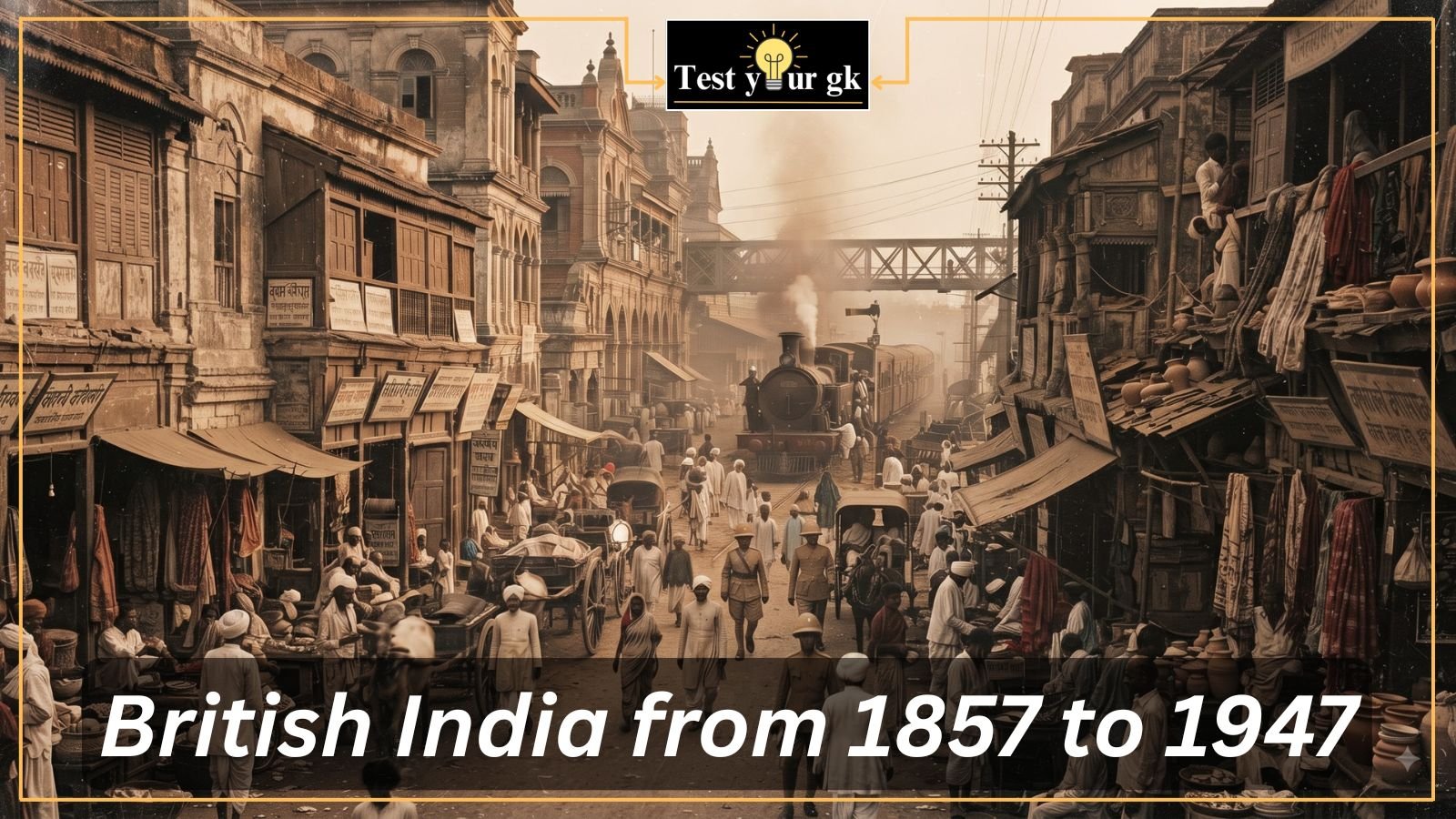
The period from 1857 to 1947 is one of the most important chapters in Modern Indian History, and it holds significant weight in the syllabus of almost every major competitive examination in India. Beginning with the Revolt of 1857 and culminating in India’s hard-won independence in 1947, this ninety-year timeline covers pivotal events such as the transfer of power to the British Crown, the rise of the Indian National Congress, the Partition of Bengal, the Home Rule Movement, the Non-Cooperation and Civil Disobedience Movements, the Quit India Movement, and finally the Partition of India.
For aspirants preparing for UPSC, SSC, Banking, Railways, and various State PSC examinations, this era is a goldmine of frequently asked questions. Examiners often test candidates on important dates, acts and policies (such as the Government of India Acts, the Rowlatt Act, and the Cripps Mission), key personalities and their contributions, significant movements and their outcomes, and important sessions of the Indian National Congress.
This compilation of 50+ GK MCQs on British India (1857–1947) has been carefully curated to cover all the essential events, personalities, and turning points of British India between 1857 and 1947. Practising these questions will not only strengthen your conceptual understanding but also help you identify recurring patterns in how this topic is tested across various exams. Attempt each question carefully, and use this set as a quick and effective tool for revision before your exam.
Q.1 The Revolt of 1857 first began at which place?
A) Delhi
B) Meerut
C) Kanpur
D) Lucknow
Answer: B) Meerut
Q.2 The Revolt of 1857 began on which date?
A) 10th May, 1857
B) 15th August, 1857
C) 26th January, 1857
D) 31st May, 1857
Answer: A) 10th May, 1857
Q.3 Who was the last Mughal emperor during the Revolt of 1857?
A) Akbar II
B) Shah Alam II
C) Bahadur Shah II
D) Farrukhsiyar
Answer: C) Bahadur Shah II
Q.4 Who led the Revolt of 1857 in Kanpur?
A) Tantia Tope
B) Nana Sahib
C) Kunwar Singh
D) Bakht Khan
Answer: B) Nana Sahib
Q.5 Who led the Revolt of 1857 in Jhansi?
A) Begum Hazrat Mahal
B) Rani Lakshmibai
C) Annie Besant
D) Sarojini Naidu
Answer: B) Rani Lakshmibai
Q.6 Who led the Revolt of 1857 in Bihar?
A) Kunwar Singh
B) Nana Sahib
C) Bakht Khan
D) Maulvi Ahmadullah Shah
Answer: A) Kunwar Singh
Q.7 Who led the Revolt of 1857 in Lucknow?
A) Begum Hazrat Mahal
B) Rani Lakshmibai
C) Rani Avantibai
D) Annie Besant
Answer: A) Begum Hazrat Mahal
Q.8 Which Governor-General was in office during the Revolt of 1857?
A) Lord Dalhousie
B) Lord Canning
C) Lord Curzon
D) Lord Ripon
Answer: B) Lord Canning
Q.9 Which Act transferred the administration of India from the East India Company to the British Crown?
A) Charter Act, 1853
B) Government of India Act, 1858
C) Indian Councils Act, 1861
D) Government of India Act, 1919
Answer: B) Government of India Act, 1858
Q.10 Who became the first Viceroy of India?
A) Lord Canning
B) Lord Curzon
C) Lord Ripon
D) Lord Mayo
Answer: A) Lord Canning
Q.11 Who announced the Queen’s Proclamation of 1858 in India?
A) Lord Canning
B) Lord Dalhousie
C) Lord Curzon
D) Lord Lytton
Answer: A) Lord Canning
Q.12 Which organisation was founded by Surendranath Banerjee and Anand Mohan?
A) East India Association
B) India Association
C) Bharat Mata Society
D) Indian National Conference
Answer: B) India Association
Q.13 Who is known as the “Grand Old Man of India”?
A) Gopal Krishna Gokhale
B) Dadabhai Naoroji
C) Bal Gangadhar Tilak
D) Surendranath Banerjee
Answer: B) Dadabhai Naoroji
Q.14 Who founded the Indian National Congress in 1885?
A) A.O. Hume
B) W.C. Bonnerjee
C) Dadabhai Naoroji
D) Lord Dufferin
Answer: A) A.O. Hume
Q.15 Where was the first session of the Indian National Congress held in 1885?
A) Calcutta
B) Bombay
C) Madras
D) Allahabad
Answer: B) Bombay
Q.16 Who was the first President of the Indian National Congress?
A) Dadabhai Naoroji
B) W.C. Bannerjee
C) A.O. Hume
D) Surendranath Banerjee
Answer: B) W.C. Bannerjee
Q.17 Who was the first British person to become President of the Indian National Congress?
A) A.O. Hume
B) George Yule
C) William Wedderburn
D) John Bright
Answer: B) George Yule
Q.18 The Indian Councils Act of 1892 mainly increased the:
A) Powers of the Viceroy
B) Number of members in legislative councils
C) Powers of Indian princes
D) Number of provincial governors
Answer: B) Number of members in legislative councils
Q.19 Who founded the Servants of India Society in 1905?
A) Bal Gangadhar Tilak
B) Gopal Krishna Gokhale
C) Lala Lajpat Rai
D) Dadabhai Naoroji
Answer: B) Gopal Krishna Gokhale
Q.20 The Partition of Bengal was announced in which year?
A) 1903
B) 1905
C) 1907
D) 1911
Answer: B) 1905
Q.21 Who was the Viceroy of India at the time of the Partition of Bengal?
A) Lord Curzon
B) Lord Minto
C) Lord Hardinge
D) Lord Dufferin
Answer: A) Lord Curzon
Q.22 The Swadeshi Movement was launched primarily in response to:
A) Rowlatt Act
B) Partition of Bengal
C) Simon Commission
D) Jallianwala Bagh massacre
Answer: B) Partition of Bengal
Q.23 In which year was the All-India Muslim League founded?
A) 1905
B) 1906
C) 1907
D) 1909
Answer: B) 1906
Q.24 Where was the All-India Muslim League founded?
A) Lahore
B) Karachi
C) Dhaka
D) Aligarh
Answer: C) Dhaka
Q.25 Who presided over the Surat Session of the Congress in 1907?
A) Dadabhai Naoroji
B) Rash Behari Ghosh
C) Gopal Krishna Gokhale
D) Lala Lajpat Rai
Answer: B) Rash Behari Ghosh
Q.26 The Surat Split of 1907 was mainly between—
A) Congress and Muslim League
B) Moderates and Extremists
C) Hindus and Muslims
D) Revolutionaries and Socialists
Answer: B) Moderates and Extremists
Q.27 Who among the following was known as “Lokmanya”?
A) Lala Lajpat Rai
B) Bal Gangadhar Tilak
C) Bipin Chandra Pal
D) Gopal Krishna Gokhale
Answer: B) Bal Gangadhar Tilak
Q.28 The Morley-Minto Reforms were introduced in which year?
A) 1905
B) 1909
C) 1911
D) 1919
Answer: B) 1909
Q.29 The Indian Councils Act of 1909 introduced:
A) Dyarchy
B) Separate electorates for Muslims
C) Provincial autonomy
D) Universal adult franchise
Answer: B) Separate electorates for Muslims
Q.30 The capital of British India was shifted from Calcutta to Delhi in—
A) 1909
B) 1911
C) 1912
D) 1915
Answer: B) 1911
Q.31 Who announced the transfer of the capital from Calcutta to Delhi?
A) Lord Curzon
B) Lord Minto
C) Lord Hardinge II
D) Lord Chelmsford
Answer: C) Lord Hardinge II
Q.32 The Partition of Bengal was annulled in which year?
A) 1909
B) 1911
C) 1915
D) 1919
Answer: B) 1911
Q.33 Who founded the Home Rule League in Madras in 1916?
A) Annie Besant
B) Sarojini Naidu
C) Aruna Asaf Ali
D) Madam Cama
Answer: A) Annie Besant
Q.34 Who founded the Home Rule League in western India?
A) Gopal Krishna Gokhale
B) Bal Gangadhar Tilak
C) Lala Lajpat Rai
D) Bipin Chandra Pal
Answer: B) Bal Gangadhar Tilak
Q.35 The Lucknow Pact of 1916 was signed between—
A) Congress and Hindu Mahasabha
B) Congress and Muslim League
C) Muslim League and British Government
D) Congress and Justice Party
Answer: B) Congress and Muslim League
Q.36 Mahatma Gandhi returned to India from South Africa in which year?
A) 1913
B) 1915
C) 1917
D) 1919
Answer: B) 1915
Q.37 Gandhi’s first major Satyagraha in India was launched at—
A) Ahmedabad
B) Champaran
C) Kheda
D) Bardoli
Answer: B) Champaran, Bihar
Q.38 The Champaran Satyagraha took place in which year?
A) 1915
B) 1917
C) 1918
D) 1920
Answer: B) 1917
Q.39 The Kheda Satyagraha was associated with—
A) Indigo cultivation
B) Peasant tax relief
C) Mill workers’ wages
D) Salt tax
Answer: B) Peasant tax relief
Q.40 The Ahmedabad Mill Strike took place in:
A) 1917
B) 1918
C) 1919
D) 1920
Answer: B) 1918
Q.41 The Rowlatt Act was passed in which year?
A) 1917
B) 1918
C) 1919
D) 1920
Answer: C) 1919
Q.42 The Rowlatt Act empowered the British Government to:
A) Grant voting rights
B) Detain people without trial
C) Abolish zamindari
D) Introduce provincial autonomy
Answer: B) Detain people without trial
Q.43 The Jallianwala Bagh massacre took place on—
A) 13 April 1919
B) 15 August 1919
C) 26 January 1920
D) 10 April 1919
Answer: A) 13th April, 1919
Q.44 Who ordered the firing at Jallianwala Bagh?
A) Lord Chelmsford
B) General Dyer
C) Lord Curzon
D) General Wavell
Answer: B) General Dyer
Q.45 The Jallianwala Bagh massacre took place at:
A) Lahore
B) Amritsar
C) Delhi
D) Ludhiana
Answer: B) Amritsar
Q.46 The Non-Cooperation Movement was launched in which year?
A) 1919
B) 1920
C) 1922
D) 1925
Answer: B) 1920
Q.47 The Non-Cooperation Movement was withdrawn after which incident?
A) Jallianwala Bagh massacre
B) Chauri Chaura incident
C) Kakori incident
D) Dandi March
Answer: B) Chauri Chaura incident
Q.48 Who founded the Swaraj Party in 1923 along with Motilal Nehru?
A) C.R. Das
B) Jawaharlal Nehru
C) Vallabhbhai Patel
D) Rajendra Prasad
Answer: A) C.R. Das
Q.49 Who died after being injured during a protest against the Simon Commission?
A) Bal Gangadhar Tilak
B) Lala Lajpat Rai
C) C.R. Das
D) Madan Mohan Malaviya
Answer: B) Lala Lajpat Rai
Q.50 The Lahore Session of the Congress in 1929 was presided over by whom?
A) Mahatma Gandhi
B) Jawaharlal Nehru
C) Vallabhbhai Patel
D) Subhas Chandra Bose
Answer: B) Jawaharlal Nehru
Q.51 The Congress declared “Purna Swaraj” as its goal at the—
A) Lucknow Session
B) Lahore Session
C) Surat Session
D) Karachi Session
Answer: B) Lahore Session
Q.52 The Civil Disobedience Movement began with the—
A) Quit India Movement
B) Dandi March
C) Champaran Satyagraha
D) Bardoli Satyagraha
Answer: B) Dandi March
Q.53 From where did Gandhi begin the Dandi March?
A) Wardha Ashram
B) Sabarmati Ashram
C) Sevagram
D) Phoenix Settlement
Answer: B) Sabarmati Ashram
Q.54 Who represented the Indian National Congress at the Second Round Table Conference?
A) Jawaharlal Nehru
B) Mahatma Gandhi
C) Vallabhbhai Patel
D) Rajendra Prasad
Answer: B) Mahatma Gandhi
Q.55 The Poona Pact of 1932 was signed between Mahatma Gandhi and:
A) Muhammad Ali Jinnah
B) B.R. Ambedkar
C) Jawaharlal Nehru
D) C. Rajagopalachari
Answer: B) B.R. Ambedkar
Q.56 The Quit India Movement was launched in—
A) 1940
B) 1941
C) 1942
D) 1943
Answer: C) 1942
Q.57 What was the famous slogan of the Quit India Movement?
A) Jai Hind
B) Do or Die
C) Inquilab Zindabad
D) Delhi Chalo
Answer: B) Do or Die
Q.58 The Cabinet Mission came to India in—
A) 1942
B) 1945
C) 1946
D) 1947
Answer: C) 1946
Q.59 The Indian Independence Act was passed by the British Parliament in—
A) June 1947
B) July 1947
C) August 1947
D) September 1947
Answer: B) July 1947
Q.60 India became independent on:
A) 26th January, 1947
B) 15th August, 1947
C) 14th August, 1947
D) 26th November, 1947
Answer: B) 15th August, 1947
Conclusion
The 1857-1947 period of British India remains a consistently high-yield topic for competitive exams, and a strong grasp of its timeline, events, and personalities can significantly boost your score in the History section. The MCQs covered in this article touch upon nearly every major milestone of this era, from the First War of Independence to the eventual transfer of power, giving you a well-rounded revision base.
We recommend re-visiting these questions periodically, as repetition is key to retaining historical facts and dates. Pay special attention to the questions you found difficult, and cross-check them against a standard reference source to strengthen your understanding further. Staying consistent with such practice sets will help you approach the History section of your exam with greater confidence and accuracy.
📚 Want to master Indian History for UPSC, SSC & PSC exams?
The below History books covers it all, simplified, exam-focused, and topper-recommended. Check those books below on Amazon👇
Best Indian History Books for General Studies (UPSC/SSC/PSC):
| Sr. No | Book | Author |
|---|---|---|
| 1. | A Brief History of Modern India (Spectrum) | Rajiv Ahir |
| 2. | India's Ancient Past | R.S. Sharma |
| 3. | History of Medieval India | Satish Chandra |
| 4. | History of Modern India | Bipan Chandra |
| 5. | India's Struggle for Independence | Bipan Chandra |
| 6. | Independent India: Before and After | Bipan Chandra |
| 7. | The Wonder That Was India | A.L. Basham |
| 8. | Ancient India, Medieval India and Modern India (NCERT Class XI/XII) | NCERT |
Keep visiting Test your gk for more such topic-wise MCQ compilations, daily quizzes, and exam-focused study material to support your preparation journey.
For daily GK updates, competitive exam preparation tips, and important static GK PDF, Join our Telegram Channel.
📚 Preparing for UPSC, SSC, Banking, RRB or State Exams?
Follow Test your gk for daily General Knowledge updates, important exam questions, and free study resources. Also checkout our social media platform.
Stay connected with testyourgk for more such exam-oriented GK content on Modern Indian History and other important subjects
Stay connected
Join our community
