Introduction
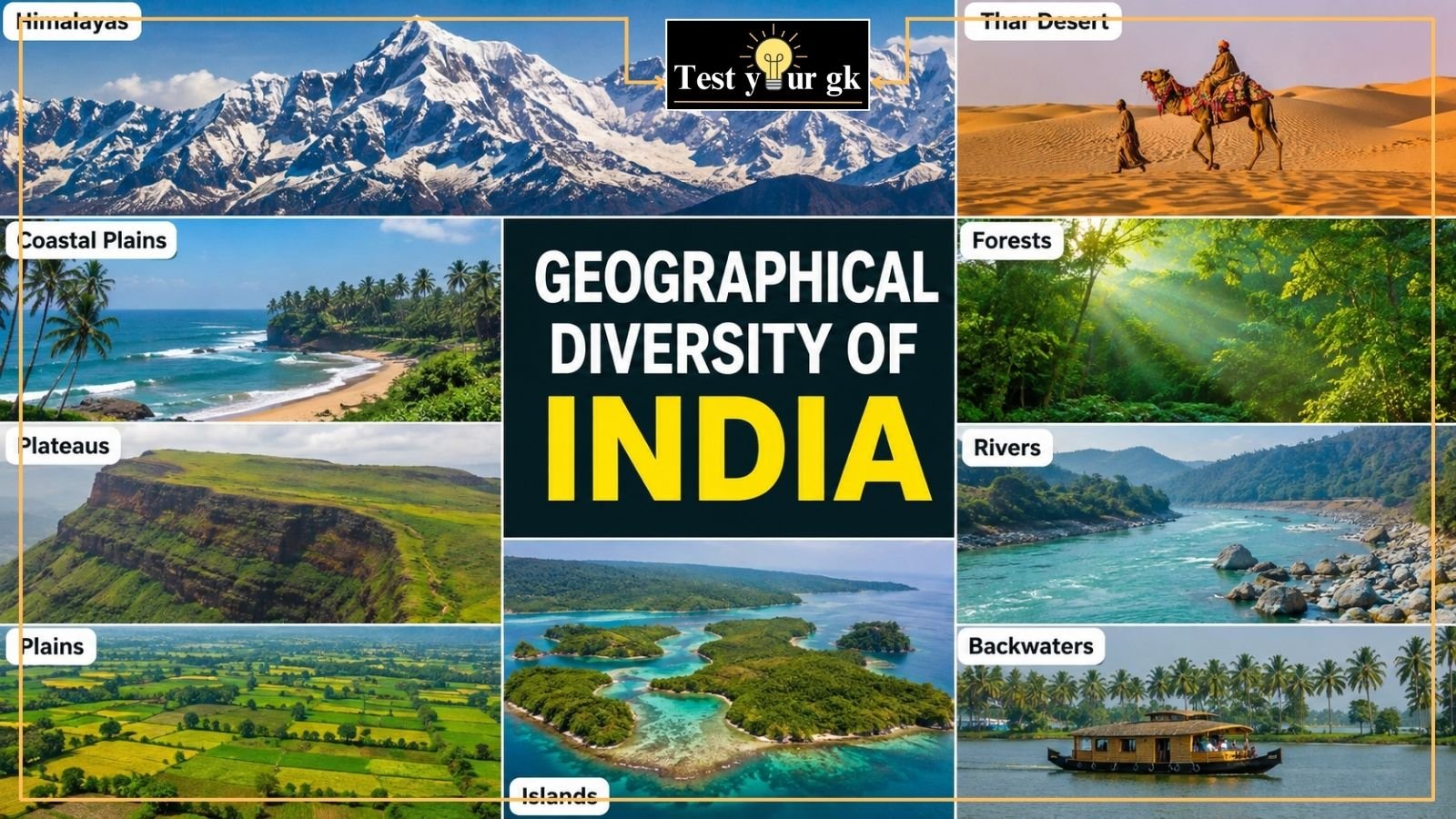
‘India’s Geographical Diversity’ is one of the most frequently tested topics across competitive examinations like UPSC, SSC, Banking, and State PSC exams. From the snow-capped peaks of the Himalayas to the coastal plains of the Deccan Plateau, from the arid Thar Desert to the fertile Indo-Gangetic plains, India’s varied physical landscape shapes its climate, agriculture, biodiversity, and even its cultural patterns. Questions on this topic are a regular feature in the General Awareness and General Studies sections, testing candidates on physiographic divisions, major mountain ranges, river systems, plateaus, coastal regions, and islands.
This set of 50+ MCQs questions has been carefully curated to cover the entire spectrum of India’s physical geography, from the Himalayan ranges and northern plains to the peninsular plateaus, coastal areas, and desert regions. Whether you are preparing for UPSC Prelims, SSC CGL, banking exams, or state-level PSC exams, these MCQs will help you strengthen your conceptual understanding while familiarizing you with the exam pattern and difficulty level typically seen in real question papers. Practicing these questions regularly will not only improve your accuracy but also build the confidence needed to tackle geography-based questions swiftly during the exam.
Below given set of 50+ Geographical Diversity of India Gk Question and Answer
Q.1 Which is the northernmost mountain range of India?
A) Aravalli Range
B) Himalayas
C) Vindhya Range
D) Satpura Range
Answer: B) Himalayas
Q.2 Which is the highest mountain peak located in India?
A) Nanda Devi
B) Kanchenjunga
C) Kamet
D) Anamudi
Answer: B) Kanchenjunga
Q.3 The Himalayas are classified as which type of mountains?
A) Block mountains
B) Residual mountains
C) Young fold mountains
D) Volcanic mountains
Answer: C) Young fold mountains
Q.4 Which is the highest peak in the Western Ghats?
A) Doddabetta
B) Anamudi
C) Mahendra Giri
D) Guru Shikhar
Answer: B) Anamudi (2,695 m)
Q.5 Which mountain range is also known as the Sahyadri?
A) Eastern Ghats
B) Western Ghats
C) Aravalli Range
D) Satpura Range
Answer: B) Western Ghats
Q.6 Which is the oldest mountain range in India?
A) Himalayas
B) Aravalli Range
C) Western Ghats
D) Satpura Range
Answer: B) Aravalli Range
Q.7 ‘Guru Shikhar’ is the highest peak of which mountain range?
A) Aravalli Range
B) Vindhya Range
C) Satpura Range
D) Western Ghats
Answer: A) Aravalli Range
Q.8 Which plateau is known as the ‘Mineral heartland’ of India?
A) Deccan Plateau
B) Chota Nagpur Plateau
C) Malwa Plateau
D) Meghalaya Plateau
Answer: B) Chota Nagpur Plateau
Q.9 Which is the largest plateau in India?
A) Malwa Plateau
B) Deccan Plateau
C) Chota Nagpur Plateau
D) Meghalaya Plateau
Answer: B) Deccan Plateau
Q.10 Which plateau lies between the Western and Eastern Ghats?
A) Deccan Plateau
B) Malwa Plateau
C) Meghalaya Plateau
D) Chota Nagpur Plateau
Answer: A) Deccan Plateau
Q.11 Which physiographic division lies between the Himalayas and the Peninsular Plateau?
A) Northern Plains
B) Coastal Plains
C) Central Highlands
D) Thar Desert
Answer: A) Northern Plains (also known as the Indo-Gangetic Plains)
Q.12 The Northern Plains of India are mainly formed by the deposits of which rivers?
A) Narmada, Tapi and Mahi
B) Indus, Ganga and Brahmaputra
C) Godavari, Krishna and Kaveri
D) Mahanadi, Narmada and Tapi
Answer: B) Indus, Ganga and Brahmaputra
Q.13 Which is the largest river basin in India?
A) Godavari Basin
B) Ganga Basin
C) Krishna Basin
D) Narmada Basin
Answer: B) Ganga Basin
Q.14 Which River is known as the ‘Dakshin Ganga’?
A) Krishna
B) Godavari
C) Kaveri
D) Mahanadi
Answer: B) Godavari
Q.15 Which River is called the ‘Sorrow of Bihar’?
A) Ganga
B) Kosi
C) Son
D) Gandak
Answer: B) Kosi
Q.16 Which state is known as the ‘Spice Garden of India’?
A) Kerala
B) Punjab
C) Gujarat
D) Odisha
Answer: A) Kerala
Also Read
Q.17 Which state is famous for the tea-growing region of Darjeeling?
A) Assam
B) West Bengal
C) Sikkim
D) Meghalaya
Answer: B) West Bengal
Q.18 Which state is the largest producer of tea in India?
A) Kerala
B) Assam
C) West Bengal
D) Tamil Nadu
Answer: B) Assam
Q.19 Which geographical feature is formed where a river deposits sediments at its mouth?
A) Gorge
B) Delta
C) Waterfall
D) Rift valley
Answer: B) Delta
Q.20 Which River flows through a rift valley?
A) Ganga
B) Narmada
C) Yamuna
D) Brahmaputra
Answer: B) Narmada
Q.21 Which River is known for forming an estuary rather than a delta?
A) Godavari
B) Krishna
C) Narmada
D) Mahanadi
Answer: C) Narmada
Q.22 Which is the largest delta in India?
A) Mahanadi Delta
B) Krishna Delta
C) Sundarbans Delta
D) Godavari Delta
Answer: C) Sundarbans Delta
Q.23 The Sundarbans are mainly located in which state of India?
A) Odisha
B) West Bengal
C) Assam
D) Bihar
Answer: B) West Bengal
Q.24 Which type of vegetation is mainly found in the Sundarbans?
A) Thorn forests
B) Mangrove forests
C) Coniferous forests
D) Tropical grasslands
Answer: B) Mangrove forests
Q.25 Which is the largest desert in India?
A) Ladakh Desert
B) Thar Desert
C) Rann of Kutch
D) Spiti Desert
Answer: B) Thar Desert, Rajasthan
Q.26 Which region of India receives very little rainfall and has an arid climate?
A) Western Rajasthan
B) Assam Valley
C) Konkan Coast
D) Meghalaya
Answer: A) Western Rajasthan
Q.27 Which mountain range separates the Thar Desert from the eastern plains?
A) Aravalli Range
B) Vindhya Range
C) Satpura Range
D) Western Ghats
Answer: A) Aravalli Range
Q.28 Which is the largest state of India by area?
A) Madhya Pradesh
B) Maharashtra
C) Rajasthan
D) Uttar Pradesh
Answer: C) Rajasthan (3,42,239 Sq.km)
Q.29 Which is the smallest state of India by area?
A) Sikkim
B) Goa
C) Tripura
D) Manipur
Answer: B) Goa (3,702 Sq.km)
Q.30 Which is the most populous state of India?
A) Maharashtra
B) Bihar
C) West Bengal
D) Uttar Pradesh
Answer: D) Uttar Pradesh
Q.31 Which state has the longest coastline in India?
A) Maharashtra
B) Tamil Nadu
C) Gujarat
D) Andhra Pradesh
Answer: C) Gujarat
Q.32 Which Indian state has the longest coastline on the eastern coast?
A) Odisha
B) Andhra Pradesh
C) Tamil Nadu
D) West Bengal
Answer: B) Andhra Pradesh
Q.33 Which is the southernmost point of mainland India?
A) Indira Point
B) Kanyakumari
C) Rameswaram
D) Kochi
Answer: B) Kanyakumari
Q.34 The Rann of Kutch is primarily a:
A) Mountain region
B) Salt marsh
C) Tropical Forest
D) River valley
Answer: B) Salt marsh
Q.35 Which is the southernmost point of India?
A) Kanyakumari
B) Indira Point
C) Port Blair
D) Rameswaram
Answer: B) Indira Point
Q.36 Which Island group lies in the Arabian Sea?
A) Andaman and Nicobar Islands
B) Lakshadweep
C) Sundarbans
D) Rameswaram
Answer: B) Lakshadweep
Q.37 Which Island group lies in the Bay of Bengal?
A) Lakshadweep
B) Andaman and Nicobar Islands
C) Daman and Diu
D) Minicoy
Answer: B) Andaman and Nicobar Islands
Q.38 Which is the largest island of India?
A) Great Nicobar
B) Majuli
C) Middle Andaman
D) Little Andaman
Answer: C) Middle Andaman
Q.39 Which is the highest waterfall in India?
A) Jog Falls
B) Dudhsagar Falls
C) Kunchikal Falls
D) Shivanasamudra Falls
Answer: C) Kunchikal Falls
Q.40 ‘Jog Falls’ is located on which river?
A) Sharavathi
B) Kaveri
C) Krishna
D) Tungabhadra
Answer: A) Sharavathi, Karnataka
Q.41 Which is the wettest place in India?
A) Cherrapunji
B) Mawsynram
C) Shillong
D) Agartala
Answer: B) Mawsynram, Meghalaya
Q.42 Which is the largest inland salt lake in India?
A) Sambhar Lake
B) Chilika Lake
C) Wular Lake
D) Loktak Lake
Answer: A) Sambhar Lake, Rajasthan
Q.43 Which state is famous for the ‘Rann of Kutch’?
A) Rajasthan
B) Gujarat
C) Maharashtra
D) Haryana
Answer: B) Gujarat
Q.44 Which is the cold desert of India?
A) Thar
B) Ladakh
C) Rann of Kutch
D) Marusthali
Answer: B) Ladakh
Q.45 Which region is known as the ‘Land of High Passes’?
A) Ladakh
B) Jammu and Kashmir
C) Himachal Pradesh
D) Uttarakhand
Answer: A) Ladakh
Q.46 Which is the highest plateau in India?
A) Malwa Plateau
B) Deccan Plateau
C) Ladakh Plateau
D) Chota Nagpur Plateau
Answer: C) Ladakh Plateau
Q.47 Which soil is most suitable for cotton cultivation?
A) Alluvial soil
B) Black soil
C) Laterite soil
D) Desert soil
Answer: B) Black soil
Q.48 Which Lake is famous for floating islands called ‘Phumdis’?
A) Loktak Lake
B) Wular Lake
C) Dal Lake
D) Sambhar Lake
Answer: A) Loktak Lake, Manipur
Q.49 Which soil is mainly formed by the deposition of rivers?
A) Black soil
B) Red soil
C) Alluvial soil
D) Laterite soil
Answer: C) Alluvial soil
Q.50 Which type of soil is widely found in the Western Ghats and parts of northeastern India?
A) Laterite soil
B) Desert soil
C) Arid soil
D) Alluvial soil
Answer: A) Laterite soil
Q.51 Which coastal plain lies between the Western Ghats and the Arabian Sea?
A) Eastern Coastal Plain
B) Western Coastal Plain
C) Northern Coastal Plain
D) Coromandel Plain
Answer: B) Western Coastal Plain
Q.52 Which coastal plain lies between the Eastern Ghats and the Bay of Bengal?
A) Western Coastal Plain
B) Eastern Coastal Plain
C) Konkan Plain
D) Malabar Plain
Answer: B) Eastern Coastal Plain
Q.53 Which is the largest freshwater lake in India?
A) Dal Lake
B) Wular Lake
C) Chilika Lake
D) Sambhar Lake
Answer: B) Wular Lake, Jammu and Kashmir
Q.54 Which is the largest brackish water lagoon in India?
A) Wular Lake
B) Chilika Lake
C) Dal Lake
D) Loktak Lake
Answer: B) Chilika Lake, Odisha
Q.55 Which is the only active volcano in India?
A) Narcondam
B) Barren Island
C) Deccan Volcano
D) Dhinodhar Hills
Answer: B) Barren Island, Andaman and Nicobar Island
Conclusion
Mastering the geographical diversity of India is essential for scoring well in the General Awareness section of competitive exams, as this topic frequently appears in various forms, direct factual questions, map-based questions, and comparative analysis.
To make the most of this practice set, revisit the questions you got wrong and revise the underlying concepts rather than just memorizing the answers. Pair this with regular reading of current affairs related to geography, such as national parks, biosphere reserves, and government geographical initiatives, since exams often blend static geography with current developments. Consistent practice, combined with focused revision, will help you retain these facts long-term and improve your overall performance in the General Studies and General Awareness sections.
📚 Want to master Indian & World Geography for UPSC, SSC & PSC exams?
This Geography books are very helpful, simplified, exam-focused, and topper-recommended. Check those books below on Amazon👇
Best Geography Books for General Studies (UPSC/SSC/PSC):
| Sr. No | Book | Author |
|---|---|---|
| 1. | Certificate Physical and Human Geography | G.C. Leong |
| 2. | Geography of India | Majid Husain |
| 3. | World Geography | Majid Husain |
| 4. | Oxford School Atlas | Oxford |
| 5. | NCERT Geography (Class 6–12) | Oswaal NCERT |
| 6. | Fundamentals of Physical Geography (NCERT Class-11) | NCERT |
For daily GK updates, competitive exam preparation tips, and important static GK PDF, Join our Telegram Channel.
📚 Preparing for UPSC, SSC, Banking, RRB or State Exams?
Follow Test your gk for daily General Knowledge updates, important exam questions, and free study resources. Also checkout our social media platform.
Keep practicing, stay consistent, and success in your exams will follow.
Stay connected
Join our community
