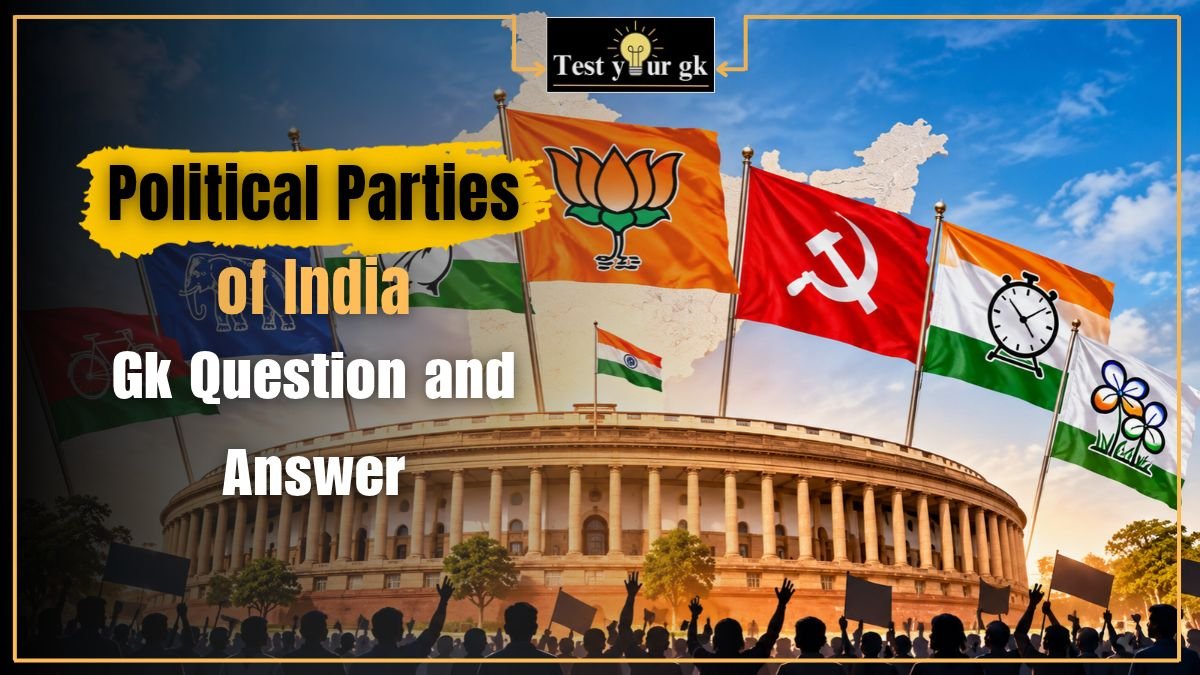
Introduction:
Political parties are the backbone of India’s parliamentary democracy. They bring citizens with similar ideas together, contest elections, form governments and act as a bridge between the people and the State. India follows a multi-party system, and the Election Commission of India (ECI) recognises parties as national parties, state parties or registered unrecognised parties on the basis of their electoral performance.
The story of Indian political parties begins with the Indian National Congress, founded on 28th December, 1885, and runs through the freedom struggle, the Congress era, the Emergency, the rise of regional parties, coalition governments and the 2024 Lok Sabha elections. Questions on this topic appear regularly in UPSC, SSC, Banking, State PSC, Railway and other competitive examinations.
Below given 50+ Political Parties of India GK MCQs:
Q.1 Who is regarded as the founder of the Indian National Congress?
A) Dadabhai Naoroji
B) Allan Octavian Hume
C) Womesh Chandra Bonnerjee
D) Gopal Krishna Gokhale
Answer: B) Allan Octavian Hume (a retired British civil servant; the party was founded on 28th December, 1885)
Q.2 Who presided over the first session of the Indian National Congress?
A) Dadabhai Naoroji
B) Badruddin Tyabji
C) Womesh Chandra Bonnerjee
D) Surendranath Banerjee
Answer: C) Womesh Chandra Bonnerjee (held on 28th December, 1885, with 72 delegates attending)
Q.3 In which city was the first session of the Indian National Congress held?
A) Calcutta
B) Madras
C) Poona
D) Bombay
Answer: D) Bombay (held at Gokuldas Tejpal Sanskrit College; it was originally planned for Poona but shifted because of an epidemic)
Q.4 Who was the first woman President of the Indian National Congress?
A) Annie Besant
B) Sarojini Naidu
C) Nellie Sengupta
D) Sucheta Kripalani
Answer: A) Annie Besant (she presided over the Calcutta session in 1917)
Q.5 Who was the first Indian woman to become President of the Indian National Congress?
A) Vijaya Lakshmi Pandit
B) Sucheta Kripalani
C) Sarojini Naidu
D) Nellie Sengupta
Answer: C) Sarojini Naidu (she presided over the Kanpur session in 1925)
Q.6 In which city was the All India Muslim League founded in 1906?
A) Lahore
B) Aligarh
C) Dhaka
D) Karachi
Answer: C) Dhaka (founded on 30th December, 1906)
Q.7 In which year was the Bharatiya Janata Party (BJP) founded?
A) 1977
B) 1980
C) 1984
D) 1989
Answer: B) 1980 (founded on 6th April, 1980; Atal Bihari Vajpayee was its first President)
Q.8 Who founded the Bharatiya Jana Sangh, the predecessor of the BJP?
A) Deendayal Upadhyaya
B) K. B. Hedgewar
C) Balraj Madhok
D) Syama Prasad Mukherjee
Answer: D) Syama Prasad Mukherjee (founded on 21st October, 1951; it merged into the Janata Party in 1977)
Q.9 What is the election symbol of the Bharatiya Janata Party?
A) Hand
B) Elephant
C) Broom
D) Lotus
Answer: D) Lotus
Q.10 What is the election symbol of the Indian National Congress?
A) Lotus
B) Elephant
C) Hand
D) Clock
Answer: C) Hand
Q.11 Who founded the Bahujan Samaj Party (BSP)?
A) Mayawati
B) Kanshi Ram
C) Ram Vilas Paswan
D) Jagjivan Ram
Answer: B) Kanshi Ram (founded on 14th April, 1984, the birth anniversary of Dr. B. R. Ambedkar; its election symbol is the elephant)
Q.12 Which BSP leader became the first Dalit woman Chief Minister of an Indian state?
A) Mayawati
B) Rabri Devi
C) Mamata Banerjee
D) J. Jayalalithaa
Answer: A) Mayawati (she first became Chief Minister of Uttar Pradesh on 3rd June, 1995)
Also Read
Q.13 Which party was founded by Arvind Kejriwal on 26th November, 2012 and uses a broom as its election symbol?
A) Aam Aadmi Party
B) Swaraj India
C) Lok Satta Party
D) Rashtriya Lok Dal
Answer: A) Aam Aadmi Party (it emerged from the India Against Corruption movement)
Q.14 In which year did the Aam Aadmi Party (AAP) receive the status of a national party?
A) 2019
B) 2021
C) 2022
D) 2023
Answer: D) 2023 (recognised by the Election Commission on 10th April, 2023)
Q.15 Which party, founded by P. A. Sangma, became the first party from the North-East to be recognised as a national party?
A) National People’s Party
B) Mizo National Front
C) Naga People’s Front
D) Asom Gana Parishad
Answer: A) National People’s Party (recognised on 7th June, 2019; its election symbol is a book)
Q.16 How many political parties are currently recognised as national parties by the Election Commission of India?
A) Four
B) Five
C) Six
D) Seven
Answer: C) Six (BJP, INC, CPI(M), BSP, AAP and NPP)
Q.17 Which authority recognises political parties as national or state parties in India?
A) Supreme Court of India
B) Parliament of India
C) President of India
D) Election Commission of India
Answer: D) Election Commission of India (under the Election Symbols (Reservation and Allotment) Order, 1968)
Q.18 Under which law are political parties registered with the Election Commission?
A) Indian Councils Act, 1909
B) Representation of the People Act, 1950
C) Government of India Act, 1935
D) Representation of the People Act, 1951
Answer: D) Representation of the People Act, 1951 (Section 29A of the Act deals with the registration of political parties)
Q.19 Which Constitutional Amendment introduced the Anti-Defection Law (Tenth Schedule)?
A) 42nd Amendment Act
B) 44th Amendment Act
C) 52nd Amendment Act
D) 61st Amendment Act
Answer: C) 52nd Amendment Act (passed in 1985)
Q.20 Who decides the disqualification of a legislator under the Anti-Defection Law?
A) President of India
B) Election Commission of India
C) Presiding Officer (Speaker or Chairman) of the House
D) Supreme Court of India
Answer: C) Presiding Officer (Speaker or Chairman) of the House (the decision is subject to judicial review, as held in the Kihoto Hollohan case (1992))
Q.21 Who founded the Rashtriya Janata Dal (RJD)?
A) Nitish Kumar
B) Ram Vilas Paswan
C) Lalu Prasad Yadav
D) Sharad Yadav
Answer: C) Lalu Prasad Yadav (founded on 5th July, 1997; its election symbol is the lantern)
Q.22 A party can be recognised as a national party if it is recognised as a state party in at least how many states?
A) Three
B) Four
C) Five
D) Six
Answer: B) Four (this is one of the three conditions laid down by the Election Commission)
Q.23 In which year did the Supreme Court direct the Election Commission to provide the NOTA option on voting machines?
A) 2011
B) 2013
C) 2015
D) 2017
Answer: B) 2013 (the verdict in PUCL v. Union of India was delivered on 27th September, 2013; NOTA stands for ‘None of the Above’)
Also Read
Q.24 Which political funding scheme did the Supreme Court strike down as unconstitutional on 15th February, 2024?
A) Electoral Bonds Scheme
B) NOTA provision
C) VVPAT system
D) Model Code of Conduct
Answer: A) Electoral Bonds Scheme (the scheme had been introduced in 2018)
Q.25 When was the Election Commission of India established?
A) 26th January, 1950
B) 25th January, 1950
C) 15th August, 1947
D) 26th November, 1949
Answer: B) 25th January, 1950 (25th January is celebrated as National Voters’ Day)
Q.26 Which Article of the Constitution vests the superintendence, direction and control of elections in the Election Commission?
A) Article 280
B) Article 315
C) Article 324
D) Article 356
Answer: C) Article 324
Q.27 Which party won the most seats in the first general election of 1951–52?
A) Indian National Congress
B) Communist Party of India
C) Socialist Party
D) Bharatiya Jana Sangh
Answer: A) Indian National Congress (it won 364 of the 489 seats; Jawaharlal Nehru became Prime Minister)
Q.28 Which party emerged as the largest opposition party in the first Lok Sabha (1952)?
A) Socialist Party
B) Bharatiya Jana Sangh
C) Communist Party of India
D) Hindu Mahasabha
Answer: C) Communist Party of India (it won 16 seats)
Q.29 Which party formed the first non-Congress government at the Centre in 1977?
A) Swatantra Party
B) Janata Dal
C) Lok Dal
D) Janata Party
Answer: D) Janata Party (Morarji Desai became Prime Minister on 24th March, 1977)
Q.30 Which of the following was not among the parties that merged to form the Janata Party in 1977?
A) Communist Party of India
B) Bharatiya Jana Sangh
C) Bharatiya Lok Dal
D) Socialist Party
Answer: A) Communist Party of India (the CPI did not join the Janata Party)
Q.31 Who was the first leader of the BJP to become Prime Minister of India?
A) L. K. Advani
B) Atal Bihari Vajpayee
C) Murli Manohar Joshi
D) Narendra Modi
Answer: B) Atal Bihari Vajpayee (he first became Prime Minister in 1996)
Q.32 For how many days did Atal Bihari Vajpayee’s first government last in 1996?
A) 13 days
B) 30 days
C) 45 days
D) 100 days
Answer: A) 13 days (sworn in on 16th May, 1996, he resigned on 28th May, 1996 before facing a vote of confidence)
Q.33 In which year was the National Democratic Alliance (NDA) formed?
A) 1996
B) 1998
C) 1999
D) 2004
Answer: B) 1998 (the first NDA government was led by Atal Bihari Vajpayee)
Q.34 Which alliance, formed in 2004, governed India under Prime Minister Manmohan Singh until 2014?
A) National Democratic Alliance
B) United Front
C) National Front
D) United Progressive Alliance
Answer: D) United Progressive Alliance (Sonia Gandhi served as its Chairperson)
Q.35 Which regional party’s continuous 24-year rule in Odisha ended after the 2024 assembly elections?
A) YSR Congress Party
B) Telangana Rashtra Samithi
C) AIADMK
D) Biju Janata Dal
Answer: D) Biju Janata Dal (Naveen Patnaik was Chief Minister from 5th March, 2000 until June, 2024)
Q.36 How many seats did the BJP win in the 2024 Lok Sabha elections?
A) 240
B) 272
C) 282
D) 303
Answer: A) 240 (results were declared on 4th June, 2024; the majority mark is 272)
Q.37 How many seats did the Indian National Congress win in the 2024 Lok Sabha elections?
A) 52
B) 99
C) 111
D) 134
Answer: B) 99 (up from 52 seats in 2019)
Q.38 Which party became the third-largest in the 18th Lok Sabha by winning 37 seats in 2024?
A) Trinamool Congress
B) Dravida Munnetra Kazhagam
C) Samajwadi Party
D) Telugu Desam Party
Answer: C) Samajwadi Party (it also became the largest party in Uttar Pradesh)
Q.39 Which party won 29 of the 42 Lok Sabha seats in West Bengal in 2024?
A) Communist Party of India (Marxist)
B) Bharatiya Janata Party
C) Indian National Congress
D) All India Trinamool Congress
Answer: D) All India Trinamool Congress (up from 22 seats in 2019)
Q.40 Which two parties, with 16 and 12 seats respectively, were the biggest allies of the BJP after the 2024 Lok Sabha elections?
A) TDP and JD(U)
B) DMK and TMC
C) SP and Shiv Sena (UBT)
D) BJD and YSRCP
Answer: A) TDP and JD(U) (TDP is led by N. Chandrababu Naidu and JD(U) by Nitish Kumar)
Q.41 How many seats did the BJP win in the 2019 Lok Sabha elections?
A) 240
B) 272
C) 303
D) 336
Answer: C) 303 (the Congress won 52 seats)
Q.42 In 2014, the BJP became the first party since 1984 to win a majority on its own. How many seats did it win?
A) 44
B) 161
C) 303
D) 282
Answer: D) 282 (the Congress won only 44 seats)
Q.43 As per convention, a party needs at least what share of the Lok Sabha’s total strength to claim the post of Leader of Opposition?
A) 5 per cent
B) 10 per cent
C) 15 per cent
D) 25 per cent
Answer: B) 10 per cent (about 55 of 543 seats; the Congress could not claim the post in 2014 (44 seats) and 2019 (52 seats))
Q.44 Which party formed the first elected communist government in Kerala in 1957?
A) Communist Party of India
B) Communist Party of India (Marxist)
C) Praja Socialist Party
D) Indian Union Muslim League
Answer: A) Communist Party of India (E. M. S. Namboodiripad became Chief Minister on 5th April, 1957; the government was dismissed in 1959 under Article 356)
Q.45 In which year was the Communist Party of India (Marxist) formed after a split in the CPI?
A) 1957
B) 1964
C) 1969
D) 1977
Answer: B) 1964 (its election symbol is the hammer, sickle and star)
Q.46 Where was the founding conference of the Communist Party of India held in December, 1925?
A) Bombay
B) Calcutta
C) Kanpur
D) Madras
Answer: C) Kanpur (the CPI traces its formal foundation to this conference)
Q.47 Who led the Left Front government in West Bengal as Chief Minister from 1977 to 2000?
A) Buddhadeb Bhattacharjee
B) E. M. S. Namboodiripad
C) Harkishan Singh Surjeet
D) Jyoti Basu
Answer: D) Jyoti Basu (the Left Front ruled West Bengal for 34 years, until 2011)
Q.48 Who founded the All India Trinamool Congress?
A) Pranab Mukherjee
B) Mamata Banerjee
C) Somnath Chatterjee
D) Siddhartha Shankar Ray
Answer: B) Mamata Banerjee (founded on 1st January, 1998; it ended the 34-year Left Front rule in West Bengal in 2011)
Q.49 Which party was founded on 10th June, 1999 by Sharad Pawar, P. A. Sangma and Tariq Anwar?
A) Nationalist Congress Party
B) Janata Dal (Secular)
C) Rashtriya Janata Dal
D) Shiv Sena
Answer: A) Nationalist Congress Party (its election symbol is the clock)
Q.50 Who founded the Samajwadi Party?
A) Charan Singh
B) Mulayam Singh Yadav
C) Akhilesh Yadav
D) Ram Manohar Lohia
Answer: B) Mulayam Singh Yadav (founded on 4th October, 1992; its election symbol is the bicycle)
Q.51 Which political party, led by Nitish Kumar, has an arrow as its election symbol?
A) Rashtriya Janata Dal
B) Lok Janshakti Party
C) Hindustani Awam Morcha
D) Janata Dal (United)
Answer: D) Janata Dal (United)
Q.52 C. N. Annadurai founded the DMK on 17th September, 1949 after breaking away from which organisation?
A) Justice Party
B) Indian National Congress
C) Swaraj Party
D) Dravidar Kazhagam
Answer: D) Dravidar Kazhagam (the Dravidar Kazhagam was led by Periyar E. V. Ramasamy; the DMK’s election symbol is the rising sun)
Q.53 Who founded the AIADMK?
A) M. Karunanidhi
B) M. G. Ramachandran
C) J. Jayalalithaa
D) Vijayakanth
Answer: B) M. G. Ramachandran (founded on 17th October, 1972; its election symbol is two leaves)
Q.54 Which regional party was founded in 1982 by film actor N. T. Rama Rao?
A) Telangana Rashtra Samithi
B) Telugu Desam Party
C) YSR Congress Party
D) Jana Sena Party
Answer: B) Telugu Desam Party (founded on 29th March, 1982; N. T. Rama Rao became Chief Minister of Andhra Pradesh in January, 1983)
Q.55 Which party led by K. Chandrashekar Rao was renamed Bharat Rashtra Samithi in 2022?
A) Telangana Rashtra Samithi
B) Praja Rajyam Party
C) Lok Satta Party
D) All India Majlis-e-Ittehadul Muslimeen
Answer: A) Telangana Rashtra Samithi (it was founded on 27th April, 2001; Telangana was formed on 2nd June, 2014)
Q.56 Which party was founded on 26th December, 1997 by Naveen Patnaik?
A) Utkal Congress
B) Odisha Jan Morcha
C) Jharkhand Vikas Morcha
D) Biju Janata Dal
Answer: D) Biju Janata Dal (named after his father Biju Patnaik; its election symbol is the conch)
Q.57 Who founded the Shiv Sena?
A) Raj Thackeray
B) Bal Thackeray
C) Narayan Rane
D) Eknath Shinde
Answer: B) Bal Thackeray (founded on 19th June, 1966 in Mumbai)
Q.58 Which regional party, founded in 1920, is among the oldest political parties in Punjab?
A) Shiromani Akali Dal
B) National Conference
C) Indian National Lok Dal
D) Peoples Democratic Party
Answer: A) Shiromani Akali Dal (founded on 14th December, 1920; its election symbol is the scales)
Q.59 Which party, associated with Shibu Soren, led the movement for a separate state of Jharkhand?
A) Jharkhand Mukti Morcha
B) Jharkhand Vikas Morcha
C) All Jharkhand Students Union
D) Rashtriya Janata Dal
Answer: A) Jharkhand Mukti Morcha (Jharkhand was created on 15th November, 2000; the JMM’s election symbol is the bow and arrow)
Q.60 Who is regarded as the founder of the Jammu and Kashmir National Conference?
A) Sheikh Abdullah
B) Mufti Mohammad Sayeed
C) Farooq Abdullah
D) Ghulam Nabi Azad
Answer: A) Sheikh Abdullah (it began as the Muslim Conference in 1932 and was renamed National Conference in 1939; its election symbol is the plough)
Conclusion:
Political parties shape the way India is governed, from the early days of the Indian National Congress to the present multi-party and coalition era. Knowing who founded a party, when it was formed, what its symbol is and how it has performed in elections is therefore a scoring area for every competitive examination.
Candidates should revise the foundation dates of the major parties, the criteria for national and state party status, the Anti-Defection Law, the main alliances (NDA, UPA and INDIA) and the Lok Sabha results of 2014, 2019 and 2024.
Want to master Indian Polity for your next exam? Explore our recommended books list below and pick the one that matches your preparation stage. [Buy Now]
| Sr. No | Book | Author |
|---|---|---|
| 1. | Indian Polity | M. Laxmikanth |
| 2. | Objective Indian Polity | M. Laxmikanth |
| 3. | Indian Constitution at Work (NCERT Class XI) | NCERT |
| 4. | Contemporary World Politics (NCERT Class XII) | NCERT |
| 5. | The Constitution of India | Dr. B.R. Ambedkar |
| 6. | Governance in India | M. Laxmikanth |
| 7. | Indian Political Thought | O.P. Gauba |
Keep practising consistently, and don’t forget to explore more GK quizzes on related topics like the Parliament, Fundamental Rights, and the Indian Constitution to build a well-rounded preparation strategy.
For daily GK updates, competitive exam preparation tips, and important static GK PDF, Join our Telegram Channel.
📚 Preparing for UPSC, SSC, Banking, RRB or State Exams?
Follow Test your gk for daily General Knowledge updates, important exam questions, and free study resources. Also checkout our social media platform.
Stay connected
Join our community
